
Introduction: Titanium’s Industrial Edge in Aggressive Environments
Industrial processing environments are not forgiving. Seawater, hot brine, chlorine compounds, nitric acid, and organic solvents attack conventional metals through every corrosion mechanism known to materials science — general corrosion, pitting, crevice attack, stress corrosion cracking, and erosion-corrosion. In these environments, material selection is not an optimization exercise; it is a reliability imperative.
Titanium alloys have carved out an indispensable role in marine and chemical processing not because they are cheap — they are not — but because they eliminate corrosion as a failure mode in applications where failure is unacceptable. A chemical plant leak can cost millions in environmental remediation and lost production. An offshore platform component failure can threaten human life. A desalination plant shutdown can deprive a city of drinking water. In these scenarios, the premium paid for titanium is not an extravagance; it is insurance against outcomes far more expensive than the material itself.
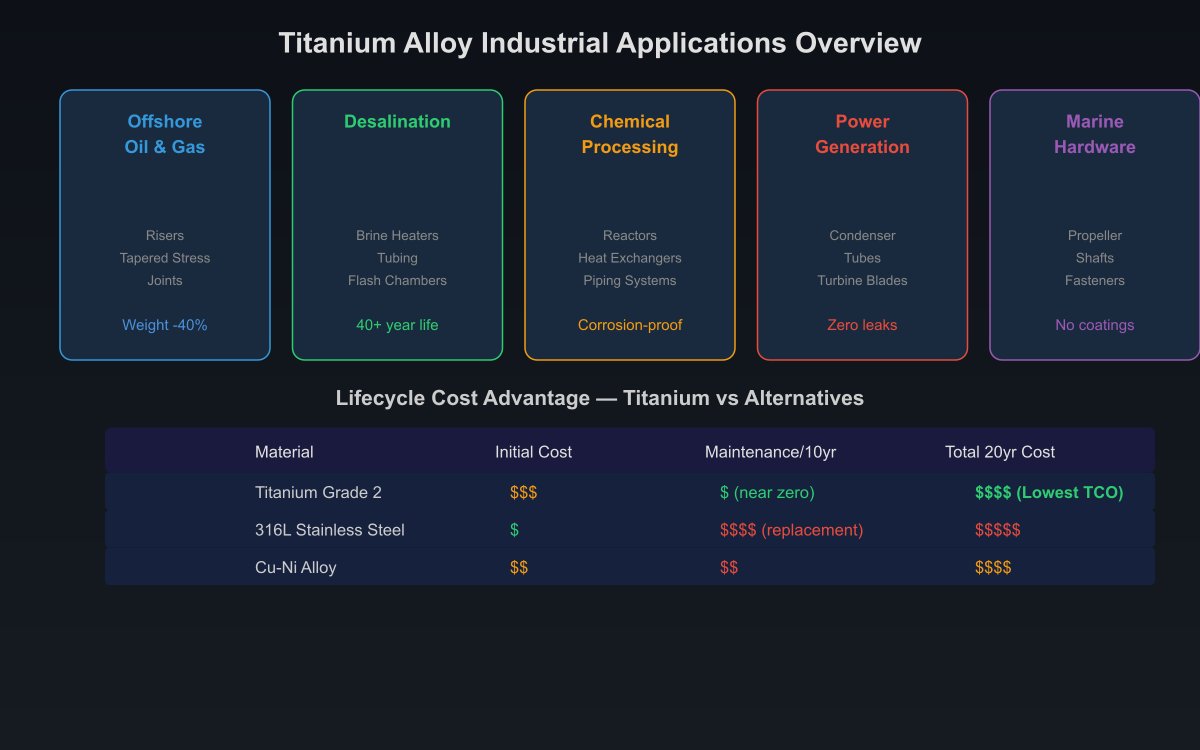
This article examines the five industrial applications where titanium alloys deliver the greatest value — not in theory, but in decades of proven service across thousands of installations worldwide.
Why Titanium Wins in Marine and Chemical Service
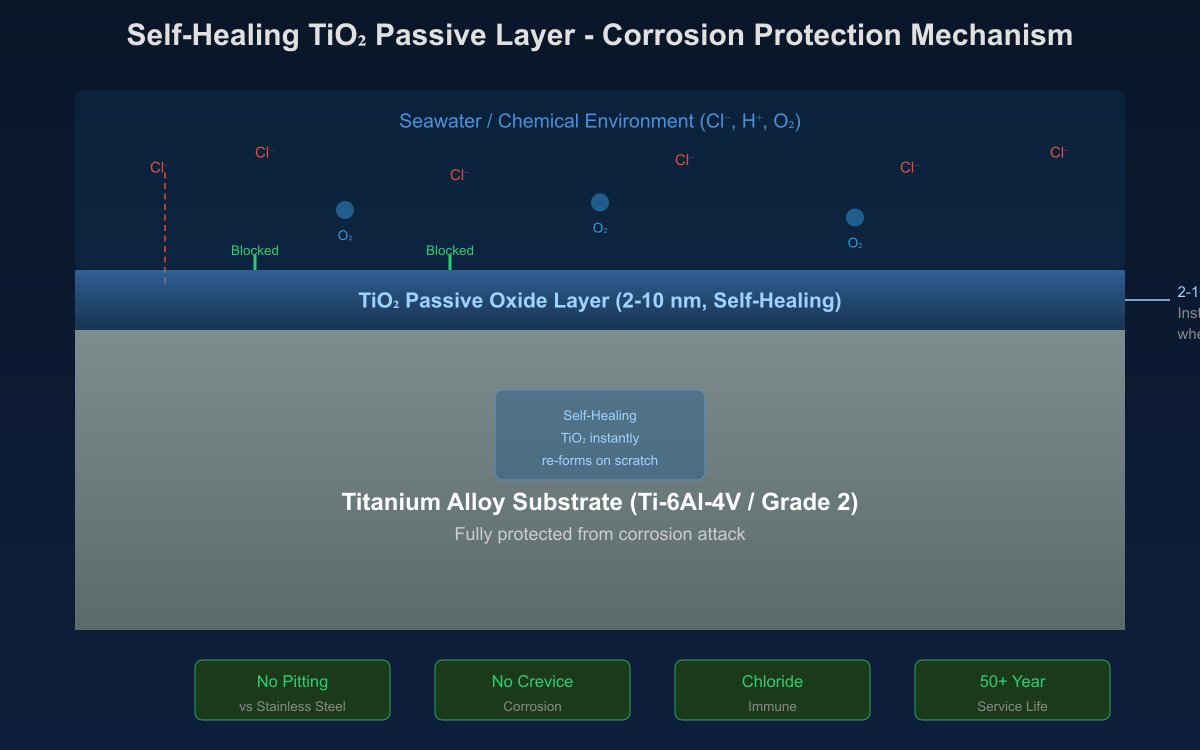
Before examining specific applications, it is worth understanding the fundamental material properties that make titanium uniquely suited to aggressive industrial environments. The answer centers on the passive oxide film — a layer of titanium dioxide (TiO₂) just 5–10 nanometers thick that forms spontaneously when titanium is exposed to oxygen, including the oxygen dissolved in water.
This film is chemically stable across an exceptionally wide range of environments. It resists chlorides (the Achilles’ heel of stainless steel), is stable in oxidizing acids including nitric acid, and withstands seawater at all naturally occurring temperatures. Unlike the chromium oxide passive film on stainless steel, titanium’s oxide does not break down locally to cause pitting or crevice corrosion. And critically, it is self-healing — any mechanical damage to the film in the presence of oxygen or water is repaired within milliseconds.
The practical consequence is that titanium equipment in marine and chemical service simply does not corrode. Not slowly, not occasionally, not in a way that can be managed with coatings or cathodic protection or chemical inhibitors — it does not corrode at all. This is the fundamental value proposition that drives titanium’s use in the five applications discussed below.
Application 1: Heat Exchangers and Condensers
Heat exchangers represent the single largest industrial application of titanium by tonnage, with over 600 million feet of titanium tubing currently in service in power plant condensers globally. The application that launched titanium into industrial prominence was power plant steam surface condensers cooled by seawater, brackish water, or cooling-tower water with high chloride content.
The Problem Titanium Solved
Before titanium, condenser tubing was predominantly copper-nickel alloys (90/10 and 70/30 Cu-Ni) or aluminum-brass. These materials suffered from multiple failure mechanisms in seawater service: erosion-corrosion at tube inlets from high-velocity water, sulfide pitting in polluted harbors, ammonia stress corrosion cracking from condenser air-cooling zone chemistry, and general thinning over time. Tube leaks allowed cooling water into the condensate, contaminating boiler feedwater and causing downstream corrosion throughout the steam cycle.
A single leaking condenser tube could force a multi-day plant shutdown costing hundreds of thousands of dollars per day. Tube replacement programs — retubing an entire condenser every 8–15 years — were budgeted as routine maintenance rather than anomalies.
The Titanium Solution
Titanium Grade 2 condenser tubing eliminated every one of these failure modes. Titanium tubes are immune to erosion-corrosion at any practical water velocity, immune to sulfide pitting, immune to ammonia attack, and do not thin or corrode over time. Nuclear and fossil power plants began converting to titanium condenser tubing in the 1970s, and the results were transformative: condenser tube leaks — one of the most common causes of forced outages — essentially disappeared from titanium-tubed units.
Beyond Power Generation
Titanium heat exchangers now serve across the process industries wherever aggressive cooling media or process fluids rule out conventional materials. Shell-and-tube exchangers with titanium tubes and tubesheets handle cooling with seawater, brackish water, and chloride-contaminated cooling tower water in refineries, LNG plants, and chemical processing facilities. Plate-and-frame exchangers with commercially pure titanium plates handle corrosive process-to-process heat recovery in chemical manufacturing. The common thread is reliability: a titanium heat exchanger specified correctly for its service conditions will not require tube replacement for the life of the facility.
Application 2: Desalination Plant Equipment
Desalination — the conversion of seawater into fresh water — is one of the most corrosion-aggressive industrial processes ever devised. It combines high temperature, concentrated brine, dissolved gases, and high fluid velocities in equipment that must operate continuously for decades to provide a city’s water supply.
Multi-Stage Flash (MSF) Desalination
MSF plants heat seawater to 90–120°C and flash it through a series of stages at progressively lower pressures. Brine heaters, flash chambers, demisters, and brine piping all operate in hot, concentrated, deaerated seawater — a combination that aggressively attacks copper-nickel and stainless steel components.
Titanium’s role in MSF plants focuses on the highest-temperature, most corrosive sections. Brine heater tubing is the critical application — temperatures of 110–120°C and brine concentrations up to 1.5 times normal seawater push 90/10 Cu-Ni and even 316L stainless steel beyond their corrosion limits. Titanium Grade 2 brine heater tubes have been standard in large MSF plants since the 1980s, with typical service lives exceeding 30 years.
Reverse Osmosis (RO) Desalination
Modern RO plants operate at pressures of 55–85 bar to force seawater through semi-permeable membranes. The high-pressure piping and fittings between the high-pressure pump and the membrane racks are typically duplex or super-duplex stainless steel, but titanium is increasingly specified for critical components: high-pressure pump internals, energy recovery device components, and concentrate discharge piping where brine concentrations are highest.
The economics favor titanium in the largest RO plants — those producing 200,000+ cubic meters per day — where a single day of unscheduled downtime can cost millions in lost water production and contractual penalties. In these mega-plants, titanium’s reliability premium is easily justified.
Application 3: Chemical Reactors and Pressure Vessels
The chemical process industries handle substances that are inherently hostile to structural metals. Chlorine compounds, nitric acid, organic acids, and chlorinated hydrocarbons attack through oxidation, reduction, and complex synergistic mechanisms. Titanium’s role in this sector is to provide a vessel, column, or pipe that contains these aggressive media for decades without degradation.
Titanium-Clad Vessels
Pure solid titanium pressure vessels are prohibitively expensive for most applications due to the high material cost. The standard solution is titanium-clad steel: a carbon or low-alloy steel pressure vessel with a thin (2–5 mm) titanium liner explosively bonded or weld-overlaid to the internal surface. The steel shell provides the pressure-containing strength at low cost; the titanium cladding provides the corrosion barrier. This approach captures titanium’s corrosion resistance at roughly 30–50% of the cost of a solid titanium vessel.
Titanium-clad reactors are standard in purified terephthalic acid (PTA) production — the feedstock for PET plastic — where the process involves acetic acid and bromide catalysts at 200–250°C. In this environment, 316L stainless steel corrodes rapidly, and even high-alloy nickel-based materials suffer attack. Titanium is one of the few materials that withstands the combination of temperature, acidity, and halide concentration over multi-year operating campaigns.
Solid Titanium Equipment
For smaller vessels, columns, and specialized reactors where the additional cost of solid titanium construction is manageable, the fully titanium option eliminates any concern about cladding integrity or differential thermal expansion between the titanium liner and steel shell. Solid titanium is common for chlorine-chemical reactors, nitric acid process equipment, and specialized pharmaceutical and fine-chemical reactors where absolute product purity is essential and even trace metal contamination from corrosion is unacceptable.
Application 4: Offshore Oil and Gas Subsea Equipment
Subsea oil and gas production operates at the frontier of materials engineering. Equipment installed on the seafloor at depths of 1,000–3,000 meters faces hydrostatic pressures exceeding 100–300 bar, seawater corrosion, internal fluid corrosion from produced hydrocarbons containing hydrogen sulfide (H₂S) and carbon dioxide (CO₂), and temperatures ranging from near-freezing at the seabed to over 200°C at the wellhead.
Titanium Riser Systems
Risers — the vertical pipes that connect subsea wellheads to surface production platforms — are one of the most demanding structural applications in offshore engineering. Steel catenary risers are heavy, requiring substantial tensioning and buoyancy systems. Titanium risers reduce weight by approximately 40% compared to steel, reducing tension requirements, simplifying platform interfaces, and improving fatigue performance in the dynamic wave and current zone near the surface.
Titanium Grade 23 ELI (Ti-6Al-4V with extra-low interstitials) is the preferred grade for riser applications due to its combination of high strength, excellent fracture toughness, and superior fatigue performance in seawater — with no susceptibility to the corrosion fatigue mechanisms that accelerate crack growth in steel risers.
Subsea Hardware and Components
Beyond risers, titanium components are increasingly found throughout subsea production systems: hydraulic and chemical injection tubing, valve and choke bodies, instrumentation housings, fasteners, and structural components. The common driver is the elimination of corrosion allowance — the extra wall thickness added to steel components to account for gradual corrosion over their service life. Titanium components can be designed to the minimum wall thickness required for pressure containment and structural loads, saving both weight and space.
Application 5: Marine Fasteners, Shafting, and Hardware
The most widespread — if not the most glamorous — industrial application of titanium is in marine fasteners and hardware. Bolts, nuts, washers, studs, screws, shafts, and fittings exposed continuously to seawater represent a maintenance burden that titanium eliminates entirely.
The Stainless Steel Fastener Problem
Stainless steel fasteners in marine service are notorious for crevice corrosion, particularly under bolt heads, within threads, and at washer interfaces where stagnant seawater creates oxygen-depleted micro-environments. The corrosion mechanism is insidious: the bolt may appear sound externally while the threaded section within the joint is aggressively corroding. Failure is often sudden and without visible warning.
The U.S. Navy documented this problem extensively in the 1970s–1990s and concluded that stainless steel fasteners were unsuitable for critical seawater-wetted applications regardless of grade — even 316L, Nitronic 50, and high-alloy duplex grades showed crevice corrosion in long-term service. The Navy’s solution was a comprehensive specification shift to titanium fasteners for seawater piping systems, valve bonnet bolts, pump casing studs, and other critical seawater-wetted threaded fasteners.
Titanium Propeller Shafts
Propeller shafts on commercial and military vessels represent another compelling application. A titanium shaft is approximately 40% lighter than its steel equivalent, which reduces bearing loads, simplifies shaft alignment, and improves rotordynamic behavior — particularly important on vessels with long shaft lines. The corrosion immunity eliminates the need for shaft coatings, sleeves at bearing and seal locations, and the periodic inspections and replacements that steel shafts require.
The material of choice is typically Ti-6Al-4V (Grade 5) for its high strength, good fatigue performance, and proven marine service record. For smaller vessels and yacht applications, Grade 2 commercially pure titanium provides adequate strength with even better corrosion resistance at lower cost.
The Lifecycle Economics That Justify Titanium
The financial case for titanium in industrial applications rests on a simple proposition: the avoided costs of corrosion-related failures, replacements, and downtime exceed the material cost premium — often by a wide margin.
Consider a medium-sized shell-and-tube heat exchanger in a chemical plant, cooling a corrosive process stream with seawater:
| Cost Category | 316L Stainless Steel | Titanium Grade 2 |
|---|---|---|
| Initial equipment cost | $120,000 | $380,000 |
| Expected service life | 5–8 years | 30+ years |
| Replacement cycles (30 years) | 4–6 | 0 |
| Total equipment cost (30 years) | $480,000–$720,000 | $380,000 |
| Installation/shutdown cost per replacement | $80,000–$200,000 | N/A |
| Total shutdown costs (30 years) | $320,000–$1,200,000 | $0 |
| Lost production per shutdown (est. 5 days) | $500,000+ | $0 |
| Total lifecycle cost (30-year range) | $1,300,000–$4,400,000+ | $380,000 |
The numbers are illustrative but representative. The key insight is that the cost of downtime and replacement — not the initial equipment price — dominates total lifecycle cost in aggressive environments. Titanium’s higher purchase price is recovered within the first avoided replacement, and every additional year of trouble-free operation is pure savings.
Grade Selection for Industrial Applications
Selecting the correct titanium grade for an industrial application requires matching the alloy’s corrosion resistance and mechanical properties to the specific service environment:
| Application | Recommended Grade | Rationale |
|---|---|---|
| Seawater cooling (all temperatures) | Grade 2 | Excellent corrosion resistance; adequate strength for tubing and thin sections |
| Hot brine, elevated temp. chloride | Grade 7 (Ti-Pd) | Palladium addition extends crevice corrosion resistance to hot, concentrated brines |
| Nitric acid service | Grade 2 or Grade 12 | Excellent resistance across wide concentration and temperature ranges |
| Wet chlorine gas | Grade 2 | Immune to wet chlorine; stainless steel is rapidly attacked |
| Reducing acid environments (HCl, H₂SO₄) | Grade 7 or Grade 12 | Enhanced resistance to reducing conditions through Pd or Mo+Ni additions |
| High-pressure structural (risers, shafts) | Grade 5 or Grade 23 | High strength required; Grade 23 ELI for fracture-critical applications |
| General structural hardware | Grade 2 or Grade 5 | Grade 2 for corrosion-limited; Grade 5 for strength-limited |
| Pharmaceutical / high-purity | Grade 2 | No alloying elements to potentially leach; lowest reactivity |
Huaxiao Alloy supplies all common industrial titanium grades in the mill forms required for equipment fabrication — tube for heat exchangers, plate for clad vessel fabrication, bar for machined components and fasteners, and pipe for process piping systems.
Fabrication and Installation Considerations
Fabricating titanium industrial equipment requires attention to several material-specific considerations that differ from steel fabrication practice:
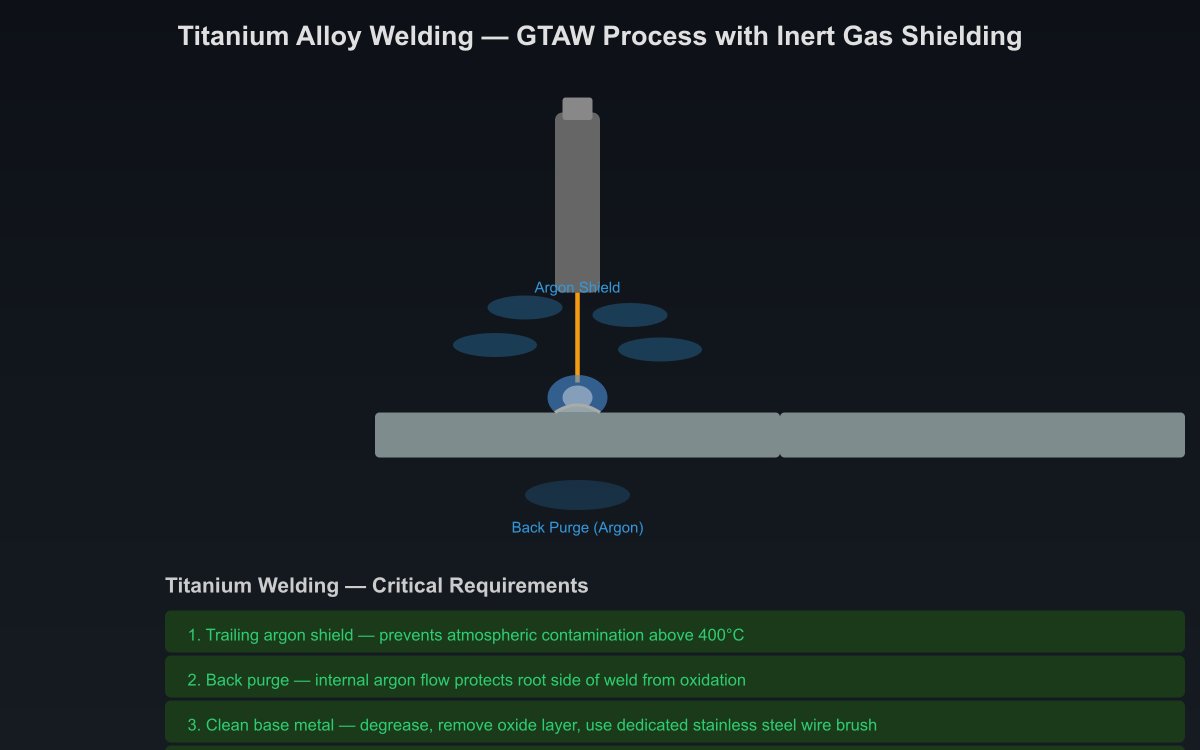
Welding: Titanium welding demands complete atmospheric shielding of the weld zone. For shop fabrication of heat exchangers and pressure vessels, this is routinely achieved with GTAW equipment incorporating trailing shields and back-purge fixtures. The procedures are well-established, and qualified titanium welders are available worldwide. The key quality-control check is weld discoloration: a properly shielded titanium weld should be bright silver. Straw or blue discoloration indicates contamination and requires removal and re-welding.
Forming: Titanium can be cold-formed, but its higher strength and lower ductility than austenitic stainless steel require more generous bend radii and higher press capacity. Hot forming at 400–600°C improves formability for complex shapes. Stress relieving after cold forming (480–650°C for 1–2 hours) is recommended to prevent stress corrosion concerns in certain chemical environments.
Galvanic Isolation: When titanium components are joined to less noble metals (carbon steel, stainless steel, copper alloys, aluminum) in the presence of an electrolyte, the titanium acts as the cathode and can accelerate corrosion of the other metal. The solution is not to avoid titanium — it is to isolate it. Non-metallic gaskets, insulating flange kits, and coating of the cathodic partner are standard practice and are well-documented in engineering standards.
Real-World Case Studies
Case Study 1: Nuclear Power Plant Condenser Retube
A 1,100 MW nuclear power plant in a coastal location was experiencing 8–12 condenser tube leaks per year with aluminum-brass tubing, each leak forcing a 2–3 day derating or shutdown at a cost of approximately $400,000 per day. The plant elected to retube the entire condenser with titanium Grade 2 tubes. Since retubing, the plant has recorded zero condenser tube leaks in over 20 years of operation. The retube project paid for itself within the first 18 months of leak-free operation.
Case Study 2: PTA Reactor Cladding
A purified terephthalic acid plant in Asia replaced a 316L stainless steel reactor that had suffered through-wall corrosion after 6 years of service in acetic acid/bromide media at 220°C. The replacement reactor was fabricated from carbon steel with 3 mm titanium Grade 2 explosive-bonded cladding. After 15 years in service, ultrasonic thickness measurements show negligible cladding loss, and the reactor has never required an unplanned shutdown for corrosion.
Case Study 3: Offshore Platform Fastener Conversion
A North Sea offshore platform replaced all stainless steel bolting on its seawater lift pump system with titanium Grade 5 fasteners after three incidents of bolt failure due to crevice corrosion over a five-year period. Each failure had required a crane-assisted pump pull at a cost exceeding $500,000. Since conversion to titanium fasteners 12 years ago, zero fastener-related pump failures have occurred.
Maintenance and Inspection of Titanium Industrial Equipment
One of titanium’s most attractive industrial attributes is the near-elimination of corrosion-related maintenance. However, “maintenance-free” should not be interpreted as “inspection-free.”
Routine inspection of titanium equipment should focus on mechanical integrity rather than corrosion: check for erosion in high-velocity areas, inspect for mechanical damage from improper cleaning or foreign object impact, verify gasket integrity at flanged joints, and confirm that galvanic isolation measures remain effective. Wall thickness measurements using ultrasonic testing can track any unexpected thinning, though properly specified titanium equipment typically shows zero measurable wall loss after decades of service.
Cleaning procedures should avoid hydrochloric acid, sulfuric acid, and fluoride-containing cleaners, which can attack the titanium oxide film. Mechanical cleaning should use non-ferrous brushes or pads to avoid iron contamination, which can cause superficial rust staining (from the embedded iron, not the titanium itself) and, in the worst case, localized corrosion if the iron particles create galvanic cells in certain chemical environments.
Sustainability and Environmental Benefits
Titanium’s role in industrial sustainability extends beyond its own longevity. By eliminating corrosion-related leaks, titanium equipment prevents the release of process chemicals and hydrocarbons into the environment — a benefit that is both ecological and financial, given the escalating cost of environmental remediation and regulatory penalties.
Titanium’s service life of 30+ years also means fewer replacement cycles, less manufacturing energy consumed over the equipment lifecycle, and reduced demand for replacement raw materials. At end of life, titanium scrap is fully recyclable: the metal can be remelted and reused without degradation of properties. The titanium recycling industry is well-established, with scrap titanium commanding high value — typically 50–70% of new metal price.
Frequently Asked Questions
Can titanium be used with sulfuric acid?
Titanium has limited resistance to sulfuric acid in its pure form. It can handle dilute concentrations (below approximately 5%) at room temperature, and slightly higher concentrations in the presence of oxidizing inhibitors. Grade 7 (Ti-Pd) and Grade 12 (Ti-0.3Mo-0.8Ni) offer improved resistance. For concentrated sulfuric acid service, high-silicon stainless steels or nickel alloys are generally preferred.
How long do titanium heat exchangers last?
Properly specified and fabricated titanium heat exchangers in seawater or chemical service routinely achieve 30–40+ year service lives with no corrosion-related failures. The first titanium-tubed power plant condensers installed in the early 1970s are still in service with their original tubing — over 50 years of continuous operation.
Is titanium resistant to chlorine?
Yes, titanium is exceptionally resistant to wet chlorine gas and chlorine compounds in aqueous solution — environments that rapidly attack stainless steel. This makes titanium the material of choice for chlorine-chemical processing equipment. Dry chlorine gas can react with titanium at elevated temperatures, but this is rarely encountered in industrial practice.
Can titanium be used for drinking water systems?
Yes. Titanium is non-toxic, does not leach metal ions into water, and is fully approved for potable water contact. Its use in drinking water is primarily limited by cost rather than any technical or regulatory restriction. Titanium is sometimes used for critical components in water treatment plants where stainless steel has proven inadequate.
Conclusion: Titanium as an Industrial Strategic Investment
Titanium alloys have earned their place in marine and chemical processing not through marketing, but through decades of documented performance in the world’s most demanding industrial environments. From the condensers that keep power plants running to the reactors that produce the chemicals modern society depends on, titanium equipment delivers a value proposition that transcends simple material cost comparison: reliability.
For plant operators, reliability means predictable production schedules, stable maintenance budgets, and the elimination of corrosion as a source of surprises. For capital project managers, specifying titanium means commissioning a facility knowing that critical equipment will outlast the depreciation schedule — and probably outlast the plant itself. For environmental managers, titanium means leak prevention that no inspection program or corrosion monitoring system can match.
At Huaxiao Alloy, we support industrial titanium applications from material supply through technical consultation. We stock grades 2, 5, 7, 12, and 23 in the mill forms required for industrial equipment fabrication. Contact our team to discuss your application requirements.
Request a quotation or technical consultation — our engineering team is ready to assist with grade selection, material specification, and supply logistics for your industrial titanium project.