
Introduction: Temperature as the Ultimate Material Eliminator
Temperature is the most unforgiving variable in material selection. Unlike corrosion, which can sometimes be managed with coatings, inhibitors, or cathodic protection, and unlike weight, which can sometimes be traded against cost, temperature imposes absolute limits that no amount of engineering cleverness can circumvent. When a material exceeds its temperature capability, it fails — predictably, progressively, and without recourse.
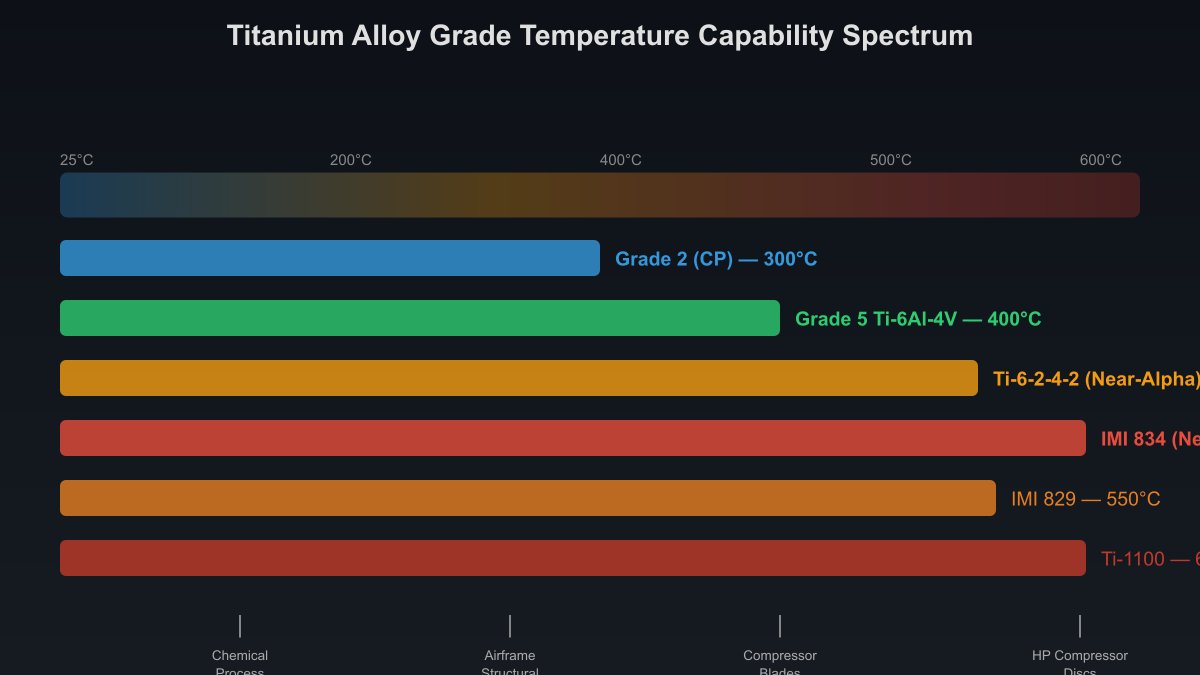
For titanium alloys, the temperature ceiling is approximately 600°C — a boundary that has been pushed upward by fifty years of alloy development but never breached. This guide explains why that ceiling exists, how different titanium grades perform across the 300–600°C spectrum, and — most importantly — how to select the right grade for your specific high-temperature application. Whether you are designing a jet engine compressor, an exhaust system, an industrial heat exchanger, or any component that must retain strength at elevated temperatures, the grade selection framework presented here will help you make an informed, defensible choice.
Titanium’s Temperature Ceiling: Why 600°C Is the Practical Limit
Every structural metal has a temperature beyond which it cannot reliably serve. For titanium alloys, this limit is fundamentally determined by three interconnected degradation mechanisms that become active at elevated temperatures: surface oxidation and alpha-case formation, creep deformation under sustained stress, and microstructural instability from phase transformations and precipitate coarsening.
The 600°C ceiling is not arbitrary — it represents the temperature at which these three mechanisms converge to make titanium alloys uneconomical relative to nickel-based superalloys. Near 600°C, oxidation rates accelerate to the point where protective measures become mandatory, creep strength drops to levels requiring excessive design margins, and the alloy microstructure — carefully engineered through composition and processing — begins to degrade at rates that limit useful service life.
This does not mean titanium cannot be used above 600°C. It means that above 600°C, the engineering compromises required to accommodate titanium’s degradation — thicker sections to compensate for metal loss from oxidation, reduced stress levels to account for creep, more frequent inspections and component replacement — tip the balance toward nickel alloys, which offer substantially better performance at a tolerable cost premium. The 600°C boundary is thus an economic optimization as much as a technical one.
Alpha-Case: The High-Temperature Surface Embrittlement Problem
Alpha-case is the single most important degradation mechanism to understand for high-temperature titanium applications. It is not a bulk material failure — it is a surface phenomenon that can initiate catastrophic failure if not properly managed.
When titanium is heated above approximately 480°C in the presence of oxygen, oxygen atoms diffuse into the metal surface and stabilize the alpha phase, creating a hard, brittle layer — the alpha-case — that can extend 50–200 microns deep depending on temperature and exposure time. This layer has negligible ductility and acts as an ideal crack initiation site under tensile or fatigue loading. A titanium component can fail from a 100-micron alpha-case layer while the remaining 99.9% of the cross-section is metallurgically sound.
Alpha-case formation follows parabolic kinetics — the layer thickness is proportional to the square root of time, meaning it grows quickly at first and then slows. At 500°C, a 50-micron alpha-case layer forms in roughly 100 hours. At 600°C, the same thickness develops in under 10 hours. This strong temperature dependence is why 600°C represents a practical limit: beyond this temperature, alpha-case formation is rapid enough that protective measures become essential for any component with a useful service life measured in thousands of hours.
Management strategies for alpha-case include: (1) machining away the alpha-case layer after processing — standard practice for forged aerospace components; (2) applying protective coatings that block oxygen diffusion; (3) designing components to operate in inert atmosphere or vacuum; and (4) accepting a finite service life with inspection intervals based on predicted alpha-case growth. For the highest-temperature applications near 600°C, option (2) — protective coatings — is increasingly standard.
Creep Behavior in Titanium Alloys at Elevated Temperature
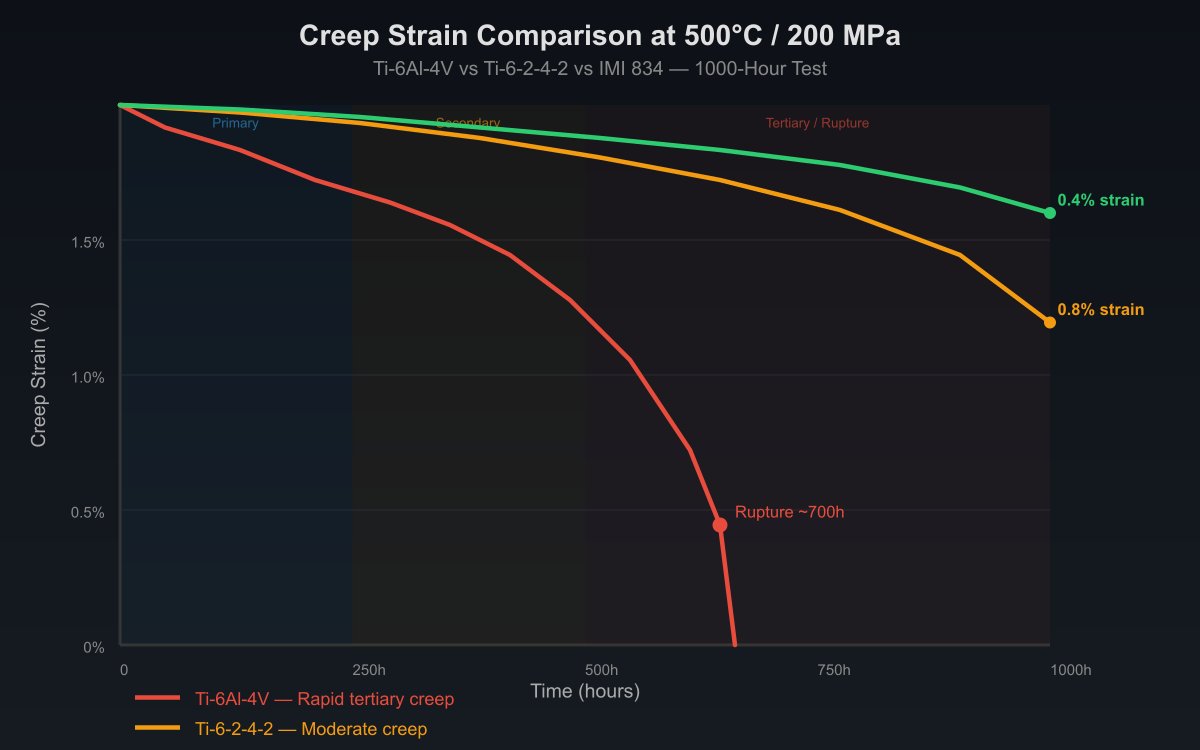
Creep — the time-dependent plastic deformation of a material under constant stress at elevated temperature — is the dominant mechanical design constraint for high-temperature titanium components. Unlike room-temperature design, where yield strength governs, elevated-temperature design must ensure that creep deformation over the component’s service life remains within acceptable limits.
Creep in titanium alloys is controlled by dislocation climb and grain boundary sliding, both of which are thermally activated processes that accelerate with temperature. The creep resistance of different titanium grades varies dramatically and is determined primarily by alloy composition and microstructure.
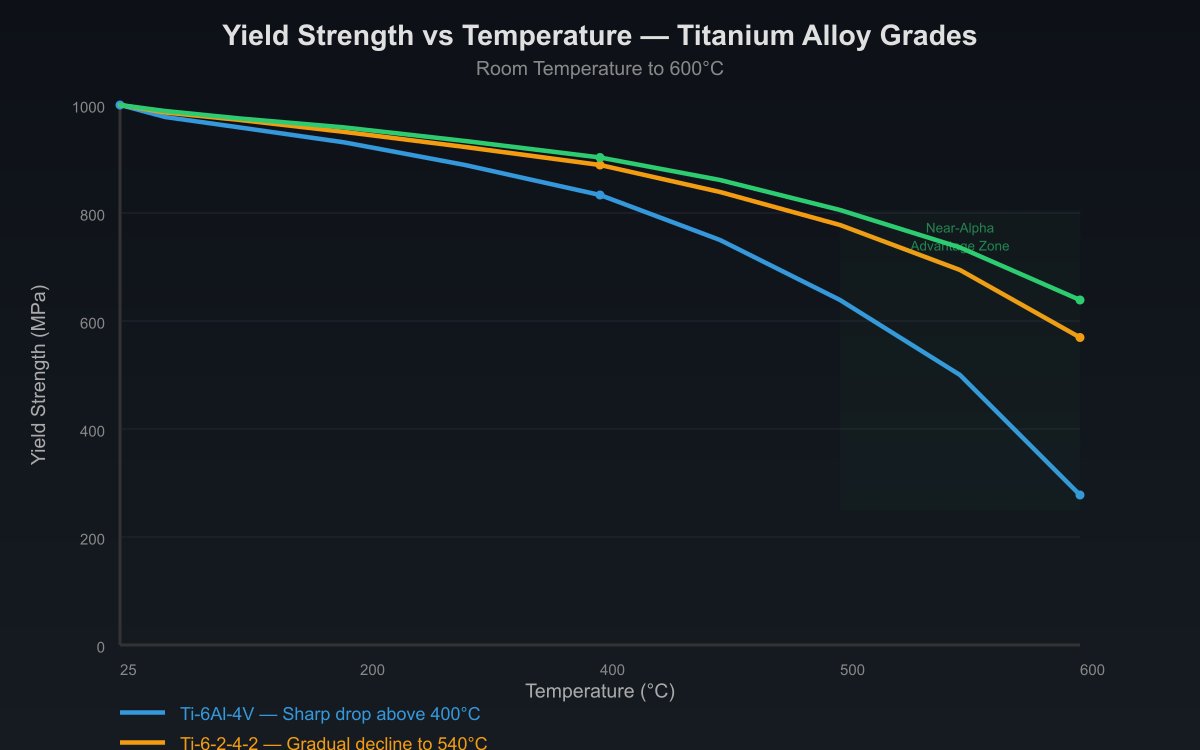
Alpha-beta alloys like Ti-6Al-4V have relatively poor creep resistance above 350°C because the beta phase provides fast diffusion paths that accelerate dislocation climb. Their practical creep-limited service ceiling is approximately 350–400°C for long-term applications.
Near-alpha alloys were specifically developed to address this limitation. By minimizing the beta phase content and adding elements that improve creep resistance, these alloys maintain useful creep strength to much higher temperatures. Key alloying strategies include:
- Silicon additions (0.1–0.5%): Silicon precipitates as fine silicide particles at alpha platelet boundaries during aging. These particles pin dislocations and inhibit grain boundary sliding — the two primary creep mechanisms in titanium. Silicon is the single most potent creep-resistance additive in titanium metallurgy, and all alloys designed for service above 500°C contain deliberate silicon additions.
- Aluminum and tin: Both are alpha stabilizers and solid-solution strengtheners that raise the temperature at which dislocation climb becomes active. Aluminum is limited to approximately 6% to avoid Ti₃Al embrittlement; tin provides additional strengthening without promoting ordered phase formation.
- Zirconium: A neutral element that strengthens both alpha and beta phases through solid-solution hardening without destabilizing the alpha microstructure.
Oxidation Behavior and Environmental Limits
While alpha-case formation is the primary surface degradation concern, general oxidation — the formation and growth of surface oxide scale — becomes a design consideration at the highest temperatures. Titanium’s oxidation behavior differs fundamentally from that of steels and nickel alloys because titanium oxide (TiO₂) is not a fully protective scale like chromia (Cr₂O₃) on stainless steels or alumina (Al₂O₃) on nickel superalloys.
Titanium oxide grows as a mixed rutile/anatase scale that is porous rather than dense, allowing continued oxygen diffusion to the metal surface. At temperatures below 400°C, oxidation rates are negligible — a few microns per year at most. Between 400–540°C, oxidation is measurable but manageable, with typical metal loss of 10–50 microns per year depending on the specific alloy and environment. Above 540°C, oxidation rates become significant, and above 600°C, they accelerate to the point where uncoated titanium is generally impractical for long-term service.
Near-alpha alloys generally exhibit better oxidation resistance than alpha-beta grades at equivalent temperatures because their higher aluminum content promotes the formation of a more protective mixed Al₂O₃-TiO₂ scale. IMI 834, with its balanced aluminum-tin-zirconium composition, offers the best oxidation resistance among commercial titanium alloys, contributing to its 600°C rating.
Environmental factors that accelerate titanium oxidation include water vapor (steam), which increases oxidation rates by 2–5 times compared to dry air at the same temperature, and halide-containing atmospheres, which can cause catastrophic oxidation through scale disruption. These environmental effects must be accounted for in grade selection and design margin calculations.
High-Temperature Titanium Grade Selection Guide
The following table provides a consolidated reference for selecting titanium grades based on service temperature, with the key mechanical properties that govern elevated-temperature design.
| Grade / Alloy | Type | Max Service Temp. (°C) | UTS at Temp (MPa) | YS at Temp (MPa) | Creep Limit (MPa / 100h / 0.1%) | Key Applications |
|---|---|---|---|---|---|---|
| Grade 2 (CP) | Alpha | ~300 | ~180 @ 300°C | ~120 @ 300°C | N/A | Low-stress chemical equipment |
| Grade 5 (Ti-6Al-4V) | Alpha-Beta | ~400 | ~550 @ 400°C | ~400 @ 400°C | ~150 @ 400°C | Compressor blades, airframes |
| Grade 9 (Ti-3Al-2.5V) | Near-Alpha | ~350 | ~400 @ 350°C | ~280 @ 350°C | N/A | Aircraft ducting, tubing |
| Ti-6Al-2Sn-4Zr-2Mo (Ti-6-2-4-2) | Near-Alpha + Si | ~540 | ~650 @ 500°C | ~450 @ 500°C | ~240 @ 500°C | Compressor discs, blades, casings |
| Ti-6Al-2Sn-4Zr-6Mo (Ti-6-2-4-6) | Alpha-Beta + Si | ~450 | ~700 @ 400°C | ~550 @ 400°C | ~180 @ 450°C | High-strength forgings, fasteners |
| IMI 685 (Ti-6Al-5Zr-0.5Mo-0.25Si) | Near-Alpha + Si | ~520 | ~600 @ 500°C | ~420 @ 500°C | ~200 @ 500°C | Compressor discs (legacy engines) |
| IMI 829 (Ti-5.5Al-3.5Sn-3Zr-1Nb-0.3Mo-0.3Si) | Near-Alpha + Si | ~550 | ~580 @ 540°C | ~400 @ 540°C | ~180 @ 540°C | Compressor discs and blades |
| IMI 834 (Ti-5.8Al-4Sn-3.5Zr-0.7Nb-0.5Mo-0.35Si) | Near-Alpha + Si | ~600 | ~550 @ 600°C | ~380 @ 600°C | ~150 @ 600°C | Highest-temp rotating Ti parts |
Near-Alpha Alloys: The High-Temperature Specialist Class
Near-alpha titanium alloys represent the most important alloy class for elevated-temperature applications above 400°C. Their defining characteristic — a microstructure that is predominantly alpha phase with minimal retained beta — directly addresses the two primary degradation mechanisms: creep (minimized by reducing fast-diffusion beta phase) and oxidation (improved through higher aluminum content).
The development of near-alpha alloys followed a logical progression. Ti-6Al-4V, the original workhorse, was limited to ~400°C by its 5–15% beta phase content. Alloy development through the 1960s–1980s systematically reduced beta content while adding silicon for creep resistance, producing a family of alloys with progressively higher temperature capabilities:
IMI 679 → IMI 685 → IMI 829 → IMI 834 represents the British development lineage from Timet UK (formerly IMI Titanium), culminating in IMI 834’s 600°C capability. The American lineage — Ti-6-2-4-2 → Ti-6-2-4-6 → Ti-1100 — followed a parallel path with different compositional optimization strategies. Both lineages converged on similar metallurgical principles: maximize alpha phase fraction, add silicon for creep resistance, and carefully balance aluminum (strength) against the Ti₃Al embrittlement threshold.

IMI 834: The 600°C Titanium Alloy
IMI 834 (Ti-5.8Al-4Sn-3.5Zr-0.7Nb-0.5Mo-0.35Si) represents the current pinnacle of high-temperature titanium alloy development. Certified for service at 600°C, it is the highest-temperature titanium alloy in commercial production and is specified for the most demanding compressor disc and blade applications in modern jet engines including the Rolls-Royce Trent series.
The alloy’s exceptional high-temperature performance derives from a carefully optimized combination of composition and processing:
- Aluminum (5.8%): Just below the Ti₃Al embrittlement threshold (~6%), maximizing solid-solution strengthening of the alpha phase without risking ordered phase formation during long-term elevated-temperature exposure.
- Tin (4%) and Zirconium (3.5%): Additional solid-solution strengtheners that do not promote Ti₃Al formation at these levels.
- Niobium (0.7%) and Molybdenum (0.5%): Modest beta stabilizer additions that provide enough beta phase for microstructural control during processing without creating the fast-diffusion paths that impair creep resistance.
- Silicon (0.35%): The creep-resistance additive. During aging, silicon precipitates as fine (50–100 nm) hexagonal silicide particles — (Ti,Zr)₅Si₃ and (Ti,Zr)₆Si₃ — that pin dislocations and grain boundaries against creep deformation.
IMI 834 is typically processed to produce a bimodal microstructure: 10–20% equiaxed primary alpha grains in a matrix of fine transformed beta lamellae. This structure optimizes the balance between creep resistance (from the lamellar transformed beta) and fatigue crack initiation resistance (from the equiaxed primary alpha). Heat treatment involves solution treating in the alpha-beta phase field at approximately 1,020°C, oil quenching, and aging at 625–700°C to precipitate silicides and stabilize the microstructure.
The alloy’s primary application is rotating components in the high-pressure compressor of large turbofan engines, where disc rim temperatures can reach 550–600°C during takeoff and climb. The combination of creep resistance, fatigue strength, and oxidation resistance at these temperatures is unmatched by any other commercial titanium alloy.
Ti-6Al-2Sn-4Zr-2Mo: The 540°C Workhorse
While IMI 834 claims the highest temperature rating, Ti-6Al-2Sn-4Zr-2Mo (commonly abbreviated Ti-6-2-4-2) is the most widely used near-alpha alloy in the 450–540°C range. Developed in the United States in the 1960s, it has accumulated the largest service experience base of any high-temperature titanium alloy and remains the standard choice for many aerospace and industrial elevated-temperature applications.
Ti-6-2-4-2 offers several practical advantages over more advanced near-alpha alloys:
- Broader availability: Ti-6-2-4-2 is produced by multiple mills globally in sheet, plate, bar, billet, and forging forms. Lead times are shorter and minimum order quantities lower than for IMI 834.
- Established specification coverage: AMS 4919 (sheet/plate), AMS 4975 (bar/forging), and comparable international standards provide a mature framework for procurement and quality assurance.
- Proven weldability: Ti-6-2-4-2 can be welded by GTAW, EBW, and laser processes with established procedures, an important consideration for fabricated structures.
- Adequate performance: For applications with maximum temperatures of 500–540°C, Ti-6-2-4-2’s creep and oxidation performance is fully satisfactory, and the higher cost of IMI 834 is not justified.
Typical applications include compressor discs, blades, and spacers in the intermediate and rear stages of aircraft engine compressors; compressor casings; afterburner components; and industrial gas turbine compressor components. The alloy is also used for high-temperature airframe structures near engines and in supersonic aircraft skin panels.
Ti-6Al-2Sn-4Zr-6Mo: Higher Strength at Moderate Temperature
Ti-6Al-2Sn-4Zr-6Mo (Ti-6-2-4-6) represents a different optimization strategy. Rather than maximizing temperature capability, it maximizes strength at intermediate temperatures (350–450°C) through higher molybdenum content (6% versus 2% in Ti-6-2-4-2). The increased beta stabilizer content enables more effective heat treatment response, producing tensile strengths exceeding 1,100 MPa in the solution-treated-and-aged condition.
The trade-off is reduced creep resistance above 450°C compared to Ti-6-2-4-2 — the higher beta phase fraction provides fast diffusion paths that accelerate creep deformation. Ti-6-2-4-6 is therefore the preferred choice when maximum static strength at moderate temperatures is required, while Ti-6-2-4-2 (or IMI 834) is preferred when creep resistance at the highest temperatures governs design.
Applications include high-strength fasteners for compressor casings and flanges, structural forgings in hot sections of airframes, and highly loaded brackets and fittings operating in the 350–450°C range.
Alpha-Beta Alloys at Elevated Temperature: When Grade 5 Stops Working
Ti-6Al-4V (Grade 5) is such a ubiquitous engineering material that engineers naturally reach for it as a default — including for elevated-temperature applications. Understanding where Ti-6Al-4V’s temperature limits lie is essential to avoid costly misapplications.
Ti-6Al-4V retains useful strength to approximately 400°C, but its performance degrades in two important ways as temperature rises: (1) creep resistance declines rapidly above 300–350°C due to the beta phase’s contribution to diffusion-controlled deformation, and (2) the alloy is not microstructurally stable over long-term exposure above 350°C — the beta phase gradually decomposes, and coarsening of the alpha phase reduces strength over time.
For short-duration or intermittent elevated-temperature exposure (minutes to hours), Ti-6Al-4V can be used to 400°C with acceptable results. For sustained exposure measured in thousands of hours — the typical requirement for compressor discs, industrial heat exchangers, and chemical process equipment — Ti-6Al-4V should be limited to approximately 300–350°C. Above this temperature, near-alpha alloys offer substantially better creep resistance and microstructural stability, and the additional material cost is almost always justified by the extended service life.
A practical guideline: if your application involves sustained stress at temperatures above 350°C for more than 1,000 hours, Ti-6Al-4V is the wrong alloy. Select a near-alpha grade appropriate for your peak temperature.
Heat Treatment Optimization for High-Temperature Performance
The heat treatment of high-temperature titanium alloys is not about maximizing room-temperature tensile properties — the approach taken for structural Ti-6Al-4V STA applications. It is about optimizing microstructure for long-term stability and creep resistance at the intended service temperature. This requires a fundamentally different heat treatment philosophy.
Solution Treatment Temperature
For near-alpha alloys, solution treatment is performed in the alpha-beta phase field, typically 30–50°C below the beta transus. This produces a bimodal microstructure with 10–20% primary alpha — the sweet spot that balances creep resistance (which improves with more lamellar transformed beta) against fatigue crack initiation resistance (which improves with more equiaxed primary alpha). Solution treating above the beta transus produces a fully lamellar structure with superior creep resistance but reduced ductility and fatigue performance.
Aging Temperature and Silicide Precipitation
For silicon-containing alloys (Ti-6-2-4-2, IMI 834, IMI 829), the aging step serves two purposes: stabilizing the transformed beta microstructure and precipitating fine silicide particles that pin dislocations during creep. Aging temperature is critical — too low, and silicide precipitation is incomplete; too high, and silicides coarsen beyond the optimal 50–100 nm size for effective dislocation pinning.
IMI 834 is typically aged at 625–700°C for 2 hours followed by air cooling. Ti-6-2-4-2 is aged at approximately 595°C for 8 hours. These parameters are established through extensive development programs and should not be modified without full qualification testing.
Stabilization Annealing
For components that will see the highest service temperatures for extended durations, a stabilization anneal at a temperature slightly above the expected service temperature can pre-condition the microstructure, reducing the rate of property change during service. This is standard practice for critical rotating engine components.
Beyond Titanium: When to Switch to Nickel Superalloys
Above 600°C, titanium alloys are progressively displaced by nickel-based superalloys (Inconel, Waspaloy, Udimet, René, and similar). The transition is driven by fundamental physics: nickel’s face-centered cubic crystal structure is inherently more creep-resistant than titanium’s hexagonal close-packed structure at high temperatures, and nickel alloys can be strengthened by a high volume fraction of coherent gamma-prime (γ’) precipitates that remain stable to temperatures approaching 1,000°C.
The decision to transition from titanium to nickel involves more than temperature:
| Factor | Titanium | Nickel Superalloy |
|---|---|---|
| Density (g/cm³) | 4.4–4.7 | 8.2–8.5 |
| Max service temperature | 600°C | 950–1,050°C |
| Cost per kg (relative) | 5–15x steel | 15–30x steel |
| Machinability | Poor | Very poor |
| Weight savings vs. Ni | Baseline | ~45% heavier |
In rotating aerospace components — compressor discs and blades — the weight penalty of switching from titanium to nickel is severe. A nickel alloy disc weighs approximately 85% more than an equivalent titanium disc, increasing not just disc weight but also shaft, bearing, and support structure weight throughout the engine. This is why engine manufacturers push titanium to its absolute limit — and why IMI 834’s 600°C capability is so valuable. Every degree of additional temperature capability from titanium delays the weight penalty of transitioning to nickel.
For static components where weight is less critical — combustor cases, turbine casings, exhaust components — the transition to nickel occurs at lower temperatures, typically 500–550°C, because the weight penalty is more tolerable and the higher cost of nickel is offset by simplified design (thinner sections for the same strength at temperature).
Practical Grade Selection Checklist
Use the following checklist when selecting a titanium alloy for elevated-temperature service. It systematically addresses the key technical and commercial factors that determine the optimal choice.
- Define peak service temperature. Include both normal operating temperature and transient peaks (engine start, process upsets, fire conditions). Add a safety margin of at least 50°C for sustained-load applications.
- Define required service life. Short-term (hours to days), medium-term (hundreds to thousands of hours), or long-term (tens of thousands of hours). Longer service life demands more conservative grade selection.
- Characterize loading. Sustained stress (creep-limited design), cyclic stress (fatigue-limited design), or intermittent stress. Creep-limited applications demand near-alpha alloys; fatigue-limited applications may tolerate alpha-beta alloys at higher temperatures.
- Assess environment. Air, combustion gases, steam, chemical process fluids, or vacuum. Oxidizing and corrosive environments may require protective coatings or grade upgrades (e.g., Grade 7 for combined temperature and corrosion).
- Determine microstructural stability requirements. Will the component see its peak temperature continuously or intermittently? Continuous exposure requires alloys with demonstrated long-term microstructural stability at that temperature.
- Evaluate fabricability. Does the component require welding, complex forming, or extensive machining? Some near-alpha alloys are more challenging to process than alpha-beta grades.
- Check availability. Confirm that the selected grade is available in the required mill form, dimensions, and quantity within your project timeline. Advanced alloys like IMI 834 may have longer lead times.
- Verify specification coverage. Ensure that material specifications exist for the selected grade and product form. For aerospace, this means AMS, MIL, or OEM-specific specifications.
- Calculate total cost. Include material, processing (machining, welding, forming), heat treatment, inspection, and certification costs. For production programs, also account for learning curve and supply chain risk.
- Document the rationale. Record why a particular grade was selected, what alternatives were considered, and what assumptions underpin the decision. This is essential for design reviews and future reference.
Aerospace Application Deep Dive: Compressor Discs and Blades
Compressor discs and blades in aircraft gas turbine engines represent the most demanding high-temperature titanium application in terms of combined temperature, stress, and reliability requirements. These are safety-critical rotating components whose failure can result in uncontained engine failure and loss of aircraft. The material selection process for these components is correspondingly rigorous.
A modern high-bypass turbofan engine contains 10–15 compressor stages operating at progressively higher temperatures and pressures. The first several stages (fan through low-pressure compressor) operate at temperatures below 300°C and can use Ti-6Al-4V. Intermediate stages at 300–450°C transition to Ti-6-2-4-2 or Ti-6-2-4-6 depending on whether creep or strength dominates the design. The final high-pressure compressor stages at 450–600°C use IMI 834 or similar advanced near-alpha alloys.
Disc design is governed by three failure modes: burst (overspeed exceeding ultimate tensile strength), low-cycle fatigue (crack initiation from the bore or rim during start-stop cycles), and creep (progressive bore growth under sustained centrifugal stress at temperature). Material selection must balance properties against all three modes simultaneously. A higher-strength alloy that improves burst margin may reduce creep resistance and increase the risk of unacceptable bore growth over thousands of flight cycles. The alloy selection that optimizes this balance has been refined over decades of engine development and is encoded in each manufacturer’s internal material standards.
Industrial High-Temperature Applications
While aerospace drives the development of advanced high-temperature titanium alloys, industrial applications benefit from the resulting alloy portfolio. Key industrial elevated-temperature applications include:
Industrial Gas Turbines: Compressor components in land-based gas turbines for power generation operate at similar temperatures to their aerospace counterparts but with different design lives (100,000+ hours versus 20,000–30,000 hours for aircraft engines). The extreme service life requirement often drives more conservative material selection — using an alloy rated for 600°C at a 500°C application to provide margin against very-long-term microstructural degradation.
Exhaust System Components: Automotive and motorsport exhaust systems, particularly turbocharger turbine housings and exhaust manifolds, see gas temperatures of 700–1,000°C but component metal temperatures are lower due to gas boundary layer effects. Titanium (typically Ti-6Al-4V or Ti-6-2-4-2) is used for exhaust components where metal temperatures stay below 500°C, providing substantial weight savings over stainless steel.
Chemical Process Equipment: Titanium reactor vessels, heat exchangers, and piping that handle hot corrosive media benefit from the combined temperature and corrosion resistance of near-alpha alloys. Ti-6-2-4-2 and Grade 7 are commonly specified for these dual-demand applications.
Geothermal Energy Equipment: Geothermal brines combine high temperature (200–350°C) with aggressive chemistry (chlorides, hydrogen sulfide, dissolved minerals). Titanium alloys, particularly Grade 7 and Grade 12 with enhanced crevice corrosion resistance, are used for heat exchanger tubing, pump components, and piping in geothermal power plants.
Testing and Qualification for High-Temperature Service
Qualifying a titanium alloy for elevated-temperature service requires more than reviewing spec-sheet values. A proper qualification program addresses the specific failure modes and service conditions the component will experience:
- Tensile testing at temperature: Not just room-temperature properties, but tensile strength and ductility at the maximum service temperature and at intermediate temperatures. The shape of the strength-versus-temperature curve matters — some alloys lose strength gradually, others precipitously near their limit.
- Creep rupture testing: The definitive test for creep-limited designs. Tests are run at service temperature and stress levels representative of the application, typically for 100–10,000 hours depending on service life requirements. Results are plotted as Larson-Miller parameter curves for design use.
- Creep strain testing: For applications where total creep strain (not rupture) is the design limit — for example, a compressor disc where excessive bore growth would cause blade tip clearance issues. Tests measure strain accumulation over time at temperature and stress.
- Oxidation exposure testing: Measures weight gain, metal loss, and alpha-case depth after exposure at temperature for durations representative of service intervals. Essential for determining whether protective coatings are required.
- Thermal stability testing: Long-term exposure at service temperature followed by room-temperature tensile testing to detect embrittlement from microstructural changes. Critical for alloys containing aluminum near the Ti₃Al formation threshold.
- Fatigue testing: Both high-cycle fatigue (HCF) at operating frequency and temperature, and low-cycle fatigue (LCF) simulating start-stop thermal-mechanical cycles. LCF is often the life-limiting mechanism for compressor discs.
- Post-exposure tensile and fatigue: Testing after simulated service exposure (temperature + environment + time) to confirm that properties have not degraded beyond design allowances.
At Huaxiao Alloy, we provide material with full certification to the applicable ASTM, AMS, or customer-specific specifications. For applications requiring additional testing beyond standard certification, we can coordinate with accredited test laboratories to provide the required data.
Frequently Asked Questions
What is the maximum temperature for titanium alloys?
The practical maximum for commercial titanium alloys in rotating aerospace applications is 600°C, achieved by IMI 834 (Ti-5.8Al-4Sn-3.5Zr-0.7Nb-0.5Mo-0.35Si). For static, non-load-bearing applications where creep is not a concern, titanium can survive short-term exposure to slightly higher temperatures, but rapid oxidation and alpha-case formation limit practical use.
Why can’t titanium be used above 600°C?
Three mechanisms converge to make titanium impractical above 600°C: (1) rapid oxidation and alpha-case formation consume the load-bearing cross-section and create brittle surface layers, (2) creep strength drops below acceptable levels for rotating or sustained-load components, and (3) the alloy microstructure degrades — phases coarsen, precipitates dissolve or over-age, and silicon-containing alloys lose their creep-enhancing silicide distribution.
Can Ti-6Al-4V be used at 500°C?
Not for sustained-load applications. Ti-6Al-4V (Grade 5) is generally limited to 350–400°C for long-term service due to inadequate creep resistance and microstructural instability above this range. For short-duration, intermittent exposure at 500°C with low sustained stress, Ti-6Al-4V may be acceptable, but a near-alpha alloy (Ti-6-2-4-2 or IMI 834) should be selected for any application involving sustained load at this temperature.
What is the difference between Ti-6-2-4-2 and IMI 834?
Ti-6-2-4-2 (Ti-6Al-2Sn-4Zr-2Mo) is rated for service to approximately 540°C and is the most widely used high-temperature titanium alloy. IMI 834 (Ti-5.8Al-4Sn-3.5Zr-0.7Nb-0.5Mo-0.35Si) extends the capability to 600°C through optimized alloy composition (reduced molybdenum, added niobium and silicon) and is specified for the hottest compressor stages in modern engines. IMI 834 is more expensive and less widely available than Ti-6-2-4-2.
How does silicon improve titanium alloy creep resistance?
Silicon (0.1–0.5%) precipitates as fine silicide particles — primarily (Ti,Zr)₅Si₃ and (Ti,Zr)₆Si₃ — at alpha platelet boundaries during aging. These particles pin dislocations against climb (the primary creep mechanism in metals at high temperature) and inhibit grain boundary sliding. Silicon is the single most effective alloying addition for improving titanium creep resistance, and all alloys rated for service above 500°C contain deliberate silicon additions.
Conclusion: Selecting with Confidence
Selecting a titanium alloy for high-temperature service is a decision with long-term consequences. Unlike room-temperature applications where a suboptimal alloy choice might mean a slightly heavier or more expensive component, an elevated-temperature misselection can mean unexpected creep deformation, surface embrittlement, or premature failure — outcomes that carry financial, operational, and in aerospace applications, safety consequences.
The principles for successful selection are clear: understand your temperature profile (peak, sustained, transient), characterize your loading (creep-limited or fatigue-limited), match the alloy’s temperature capability to your requirements with appropriate margin, and verify through testing that the selected alloy performs as expected in your specific environment and loading conditions.
At Huaxiao Alloy, we supply the full range of titanium grades for elevated-temperature service — from Ti-6Al-4V for moderate-temperature applications through Ti-6-2-4-2 for intermediate-temperature service to IMI 834 for the most demanding 600°C requirements. Our technical team can assist with grade selection, material specification, and supply of certified material for your high-temperature application.
Contact our engineering team to discuss your high-temperature titanium alloy requirements. We provide material selection support, certified product with full traceability, and competitive lead times for both standard and advanced alloy grades.