
Introduction: Why Ti-6Al-4V Dominates the Titanium Market
Walk into any aerospace machine shop, medical device manufacturer, or high-performance engineering facility, and you are almost certain to find Ti-6Al-4V. Known interchangeably as ASTM Grade 5, UNS R56400, or simply “6-4 titanium,” this single alloy accounts for approximately 50% of all titanium consumed globally. It powers the fan blades of commercial jet engines, forms the hip stems that keep elderly patients mobile, and spins inside Formula 1 turbochargers at 150,000 RPM.
What sets Ti-6Al-4V apart is not that it excels at any one property — other alloys are stronger, more corrosion-resistant, or easier to machine — but that it delivers a uniquely balanced combination of strength, toughness, thermal stability, fabricability, and cost-effectiveness that no competitor alloy has matched in over six decades of service. It is the generalist that performs like a specialist, and that versatility has made it indispensable across industries with wildly different requirements.
This comprehensive guide covers everything engineers, procurement managers, and fabricators need to know about Ti-6Al-4V: its metallurgy, mechanical properties across all heat treatment conditions, primary applications in each major industry, machining and welding best practices, and the forms and grades available from Huaxiao Alloy.

Chemical Composition and Metallurgy of Ti-6Al-4V
Ti-6Al-4V is an alpha-beta titanium alloy whose name encodes its primary alloying elements: nominally 6% aluminum and 4% vanadium by weight. The aluminum stabilizes the hexagonal close-packed alpha phase, providing solid-solution strengthening and reducing density. The vanadium stabilizes the body-centered cubic beta phase, increasing ductility, enabling heat treatment response, and improving hot workability.
The standard chemical composition per ASTM B265, B348, and AMS 4911 is:
| Element | Weight % | Role |
|---|---|---|
| Aluminum (Al) | 5.50–6.75 | Alpha stabilizer, strength, reduced density |
| Vanadium (V) | 3.50–4.50 | Beta stabilizer, ductility, heat treatment response |
| Iron (Fe) | Max 0.30 (Grade 5) / 0.25 (Grade 23 ELI) | Incidental beta stabilizer |
| Oxygen (O) | Max 0.20 (Grade 5) / 0.13 (Grade 23 ELI) | Interstitial strengthener; tightly controlled |
| Carbon (C) | Max 0.08 | Interstitial impurity |
| Nitrogen (N) | Max 0.05 | Interstitial impurity |
| Hydrogen (H) | Max 0.015 | Embrittlement risk; strictly limited |
| Yttrium (Y) | Max 0.005 | Trace; controlled for rotating-grade material |
| Titanium (Ti) | Balance | Base metal |
The aluminum content is the primary strength driver through solid-solution hardening of the alpha phase. However, aluminum is limited to approximately 6% because higher concentrations promote the formation of Ti₃Al (alpha-2) precipitates, which embrittle the alloy. Vanadium at 4% provides enough beta phase at room temperature — typically 5–15 volume percent in the mill-annealed condition — to enable heat treatment while maintaining good weldability.
Oxygen content deserves special attention because it profoundly influences mechanical behavior. Oxygen is an effective and inexpensive strengthener in titanium, but at elevated levels it reduces ductility, fracture toughness, and stress corrosion resistance. The distinction between Grade 5 (max 0.20% O) and Grade 23 ELI (max 0.13% O) is primarily oxygen control — the ELI variant sacrifices approximately 10% of its tensile strength in exchange for significantly improved fracture toughness and damage tolerance.
Mechanical Properties Across Heat Treatment Conditions
One of Ti-6Al-4V’s greatest strengths as an engineering material is its flexibility: through different heat treatment routes, the same alloy composition can deliver substantially different property combinations to suit specific applications. The table below summarizes the key mechanical properties across the most common conditions.
| Condition | Tensile (MPa) | Yield (MPa) | Elong. (%) | RA (%) | KIC (MPa√m) |
|---|---|---|---|---|---|
| Mill Annealed (700–785°C) | 895 min | 828 min | 10 min | 25 min | ~50–65 |
| Beta Annealed | 895 min | 828 min | 8 min | 20 min | ~65–80 |
| Solution Treated + Aged (STA) | 1,100 min | 1,000 min | 8 min | 20 min | ~35–50 |
| Duplex Annealed | 930 min | 860 min | 10 min | 25 min | ~55–70 |
| Grade 23 ELI (Mill Annealed) | 828 min | 759 min | 10 min | 25 min | ~75–90 |
Mill Annealed — The Baseline Condition
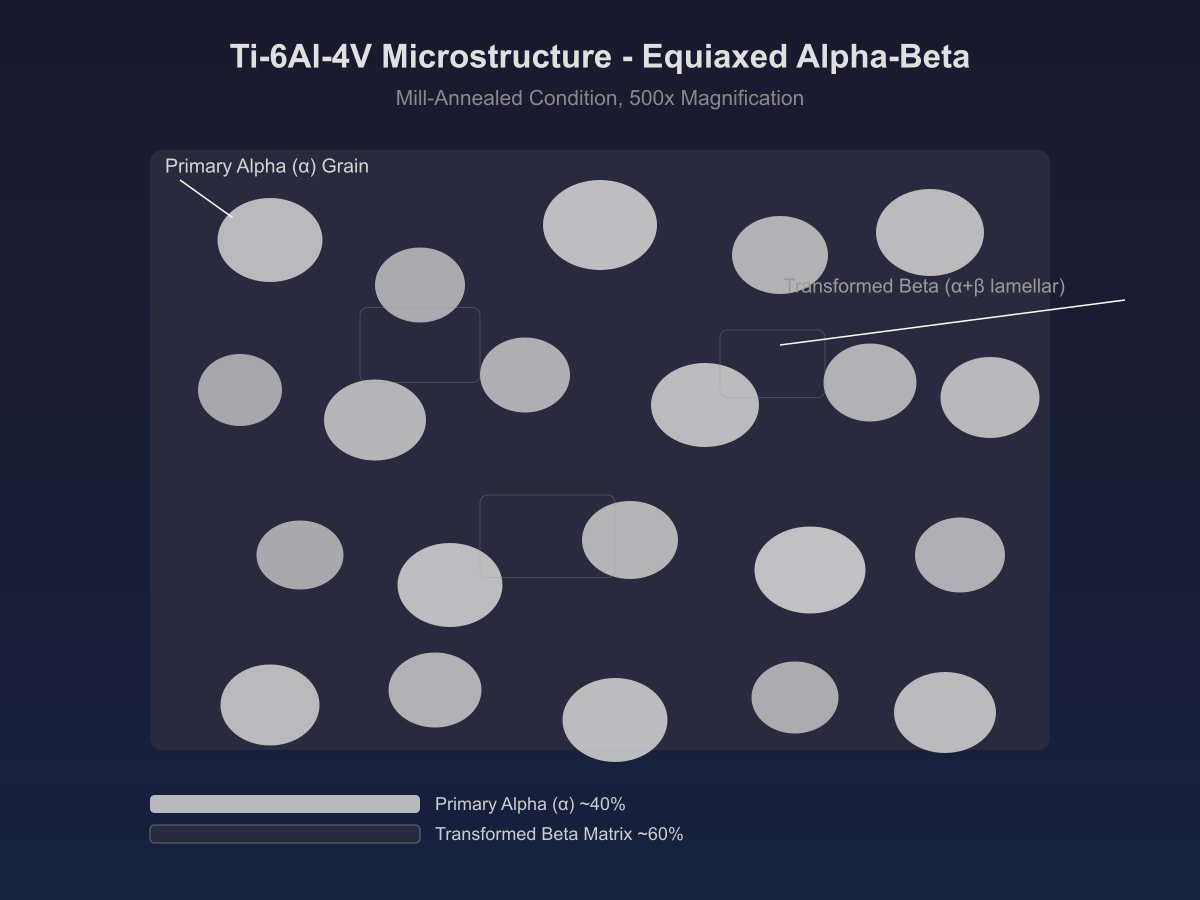
Mill annealing involves heating to 700–785°C, holding for a time determined by section thickness (typically 1–4 hours), and cooling in air. This produces an equiaxed alpha microstructure with 5–15% retained beta at alpha grain boundaries. It is the most common delivery condition and provides the best balance of strength, ductility, and toughness for general-purpose applications.
Solution Treated and Aged (STA) — Maximum Strength
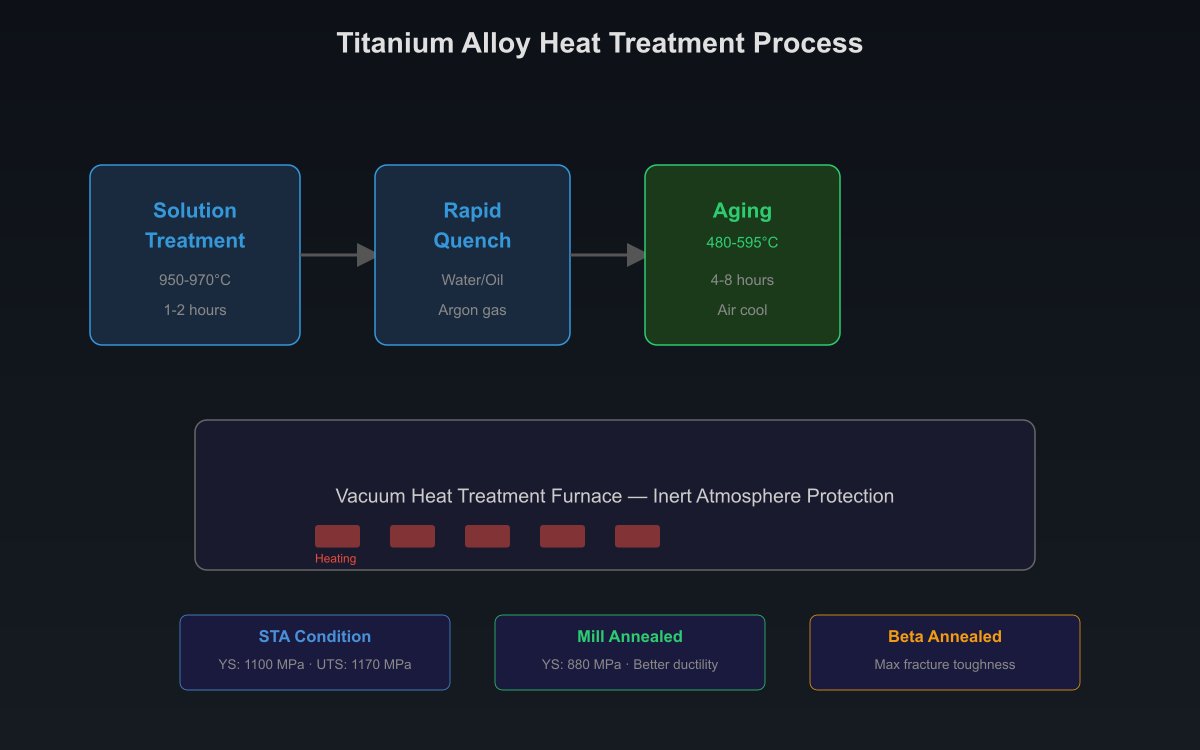
For applications demanding the highest possible strength, STA heat treatment delivers. The material is solution-treated in the alpha-beta phase field (typically 925–955°C), rapidly quenched to retain a supersaturated beta phase, then aged at 480–595°C to precipitate fine alpha particles within the beta. This precipitation hardening boosts tensile strength beyond 1,100 MPa — but reduces fracture toughness by 30–40% compared to the mill-annealed condition. STA is specified for high-strength fasteners, landing gear components, and structural forgings where maximum static strength is required and fracture-critical design is not the limiting factor.
Beta Annealed — Maximum Fracture Toughness
When damage tolerance is the overriding design requirement, beta annealing is the preferred route. The material is heated above the beta transus (~995°C), transforming entirely to beta phase, then cooled at a controlled rate. This produces a lamellar (Widmanstatten) alpha-beta microstructure with superior fracture toughness and fatigue crack growth resistance at the expense of some tensile ductility. Beta-annealed Ti-6Al-4V is widely specified for fracture-critical bulkheads and frames in military aircraft.
Microstructure Evolution and Its Effect on Properties
The mechanical properties of Ti-6Al-4V are ultimately determined by its microstructure — the size, shape, and distribution of alpha and beta phases — which in turn is controlled by thermomechanical processing history. Understanding these structure-property relationships is essential for specifying the correct material condition.
Three fundamental microstructural types exist in Ti-6Al-4V:
Equiaxed (Mill Annealed): Produced by working and annealing in the alpha-beta phase field. Primary alpha grains are roughly spherical and 5–20 microns in diameter, with beta phase at grain boundaries. This structure offers the best balance of tensile properties — high ductility, good low-cycle fatigue resistance — and is the default for most applications. It is also the starting point for further heat treatment.
Lamellar (Beta Processed): Produced by processing above the beta transus. Alpha phase precipitates as plates or lamellae within prior beta grains during cooling, creating a basket-weave or colony structure. Lamellar microstructures provide superior fracture toughness, fatigue crack growth resistance, and creep resistance at elevated temperatures, but lower tensile ductility. Beta processing is common for forged aerospace components where damage tolerance governs.
Bimodal (Duplex Annealed): A deliberate mixture of equiaxed primary alpha (~20–30%) in a transformed beta matrix, produced by solution treating just below the beta transus followed by aging. Bimodal microstructures offer an optimized compromise — better fatigue initiation resistance than lamellar structures and better creep resistance than fully equiaxed structures. This is the preferred condition for many rotating engine components.
Heat Treatment Processes for Ti-6Al-4V
Effective heat treatment of Ti-6Al-4V requires precise temperature control, proper atmosphere management, and attention to section thickness effects. Unlike steel, titanium cannot be hardened through martensitic transformation; strengthening comes from controlling the size, morphology, and distribution of the alpha and beta phases.
Stress Relieving
Residual stresses from machining, forming, or welding can be reduced by heating to 480–650°C for 1–4 hours followed by air cooling. Stress relieving does not significantly alter microstructure or mechanical properties but is essential for maintaining dimensional stability during subsequent machining of complex parts. As a rule of thumb, stress relieve after rough machining, before finish machining.
Mill Annealing
The standard delivery condition. Heat to 700–785°C, hold for 1–4 hours depending on section thickness, air cool. Produces an equiaxed alpha-beta microstructure with properties per the table above. This is appropriate for the majority of structural applications.
Solution Treatment and Aging (STA)
Solution treat at 925–955°C (below the beta transus) to dissolve beta-stabilized regions, quench in water or oil (thin sections) or forced air (thick sections), then age at 480–595°C for 4–8 hours. The aging step precipitates fine alpha particles in the retained beta phase, substantially increasing strength. Temperature control is critical: overshooting the beta transus by even 10–15°C produces a coarse lamellar structure with reduced ductility that cannot be corrected by aging.
Aerospace Applications: From Airframes to Jet Engines
Aerospace is the largest and most demanding market for Ti-6Al-4V. The alloy’s combination of high specific strength, fatigue resistance, and thermal stability to 400°C makes it the default material for a vast range of aircraft structural and engine components.
Airframe Structures: Ti-6Al-4V forgings and plate are used for wing attachment fittings, landing gear support structures, engine pylons, and critical bolted joints. On the Boeing 787, titanium accounts for approximately 15% of structural weight, much of it Ti-6Al-4V. The alloy is particularly valuable at interfaces between carbon-fiber composite and aluminum structure, where it eliminates galvanic corrosion concerns.
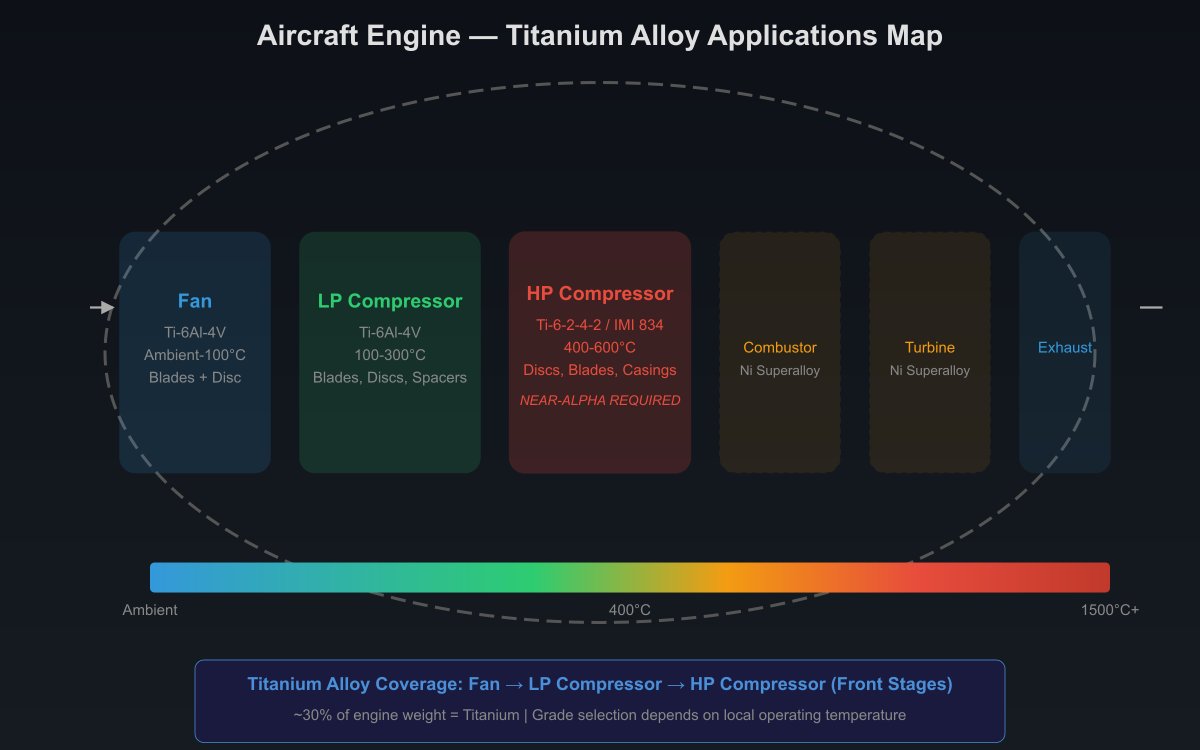
Gas Turbine Engines: Compressor blades, discs, spacers, and casings in the cold section — from the fan through the final high-pressure compressor stage — are predominantly Ti-6Al-4V. The alloy can operate continuously at temperatures up to 300°C and for limited durations at 400°C. For compressor stages operating above 450°C, near-alpha alloys like Ti-6-2-4-2 replace Ti-6Al-4V.
Fasteners: Aerospace fasteners made from STA Ti-6Al-4V replace steel fasteners to save weight — a large commercial aircraft contains hundreds of thousands of fasteners, and the cumulative weight savings are substantial. Titanium fasteners also eliminate the need for cadmium plating, which is being phased out due to environmental regulations.
Medical Implant Applications of Ti-6Al-4V ELI
The medical device industry is the second-largest consumer of Ti-6Al-4V and arguably its most quality-critical application. When a component is destined to remain inside a human body for decades, there is no margin for material defects or property variations.
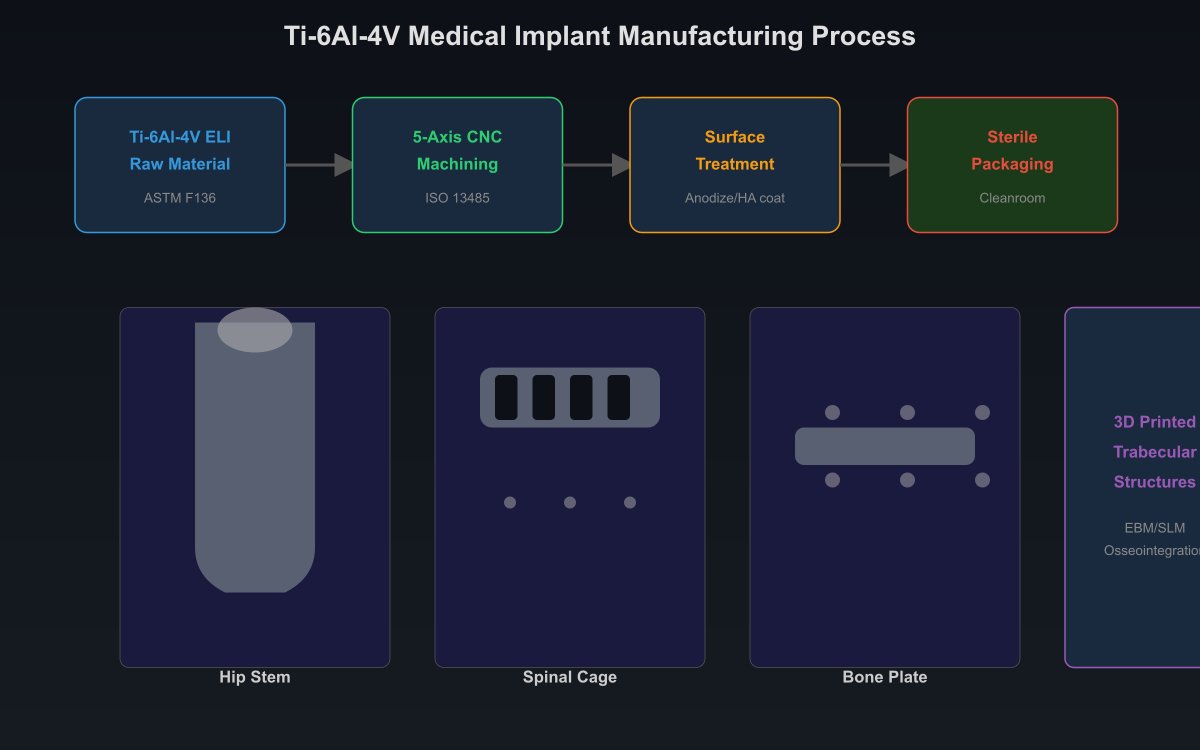
Orthopedic Implants: Hip replacement stems, acetabular cups, knee femoral and tibial components, shoulder joints, spinal fusion cages, and trauma fixation plates are manufactured from Ti-6Al-4V ELI (ASTM F136 for wrought material, F1108 for castings). The ELI grade is specified for its superior fracture toughness, which is essential for load-bearing implants subjected to millions of gait cycles.
The elastic modulus of Ti-6Al-4V (approximately 110 GPa) is closer to cortical bone (10–30 GPa) than cobalt-chromium alloys (200–240 GPa) or stainless steel (~200 GPa). This reduces stress shielding — the phenomenon where a stiff implant bears load that the surrounding bone would normally carry, leading to bone resorption and eventual implant loosening. It is the single most important mechanical design consideration for load-bearing orthopedic implants.
Dental Implants: Modern two-piece dental implant systems typically use Grade 4 CP titanium for the endosseous fixture (the threaded portion embedded in the jawbone) and Ti-6Al-4V for the abutment and prosthetic retaining screw. The higher strength of Ti-6Al-4V is needed to resist the bending and fatigue loads on the abutment connection.
Ti-6Al-4V in Additive Manufacturing: 3D Printing Titanium
Ti-6Al-4V is the most widely 3D-printed structural metal alloy, driven by its established properties, broad specification coverage, and the fact that titanium’s high buy-to-fly ratio in conventional machining (often 10:1 or worse for complex aerospace parts) makes additive manufacturing economically compelling.
Powder Bed Fusion: Selective Laser Melting (SLM) and Electron Beam Melting (EBM) are the dominant processes. Both use Ti-6Al-4V powder (typically 15–45 micron for SLM, 45–106 micron for EBM) spread in thin layers and selectively melted by a laser or electron beam. As-built material typically requires post-processing — stress relief, hot isostatic pressing (HIP) to close internal porosity, and surface finishing — to achieve mechanical properties equivalent to wrought material.
Advantages Over Conventional Processing: Additive manufacturing unlocks geometries impossible through forging or machining: internal cooling channels, lattice structures for bone ingrowth in medical implants, topology-optimized brackets that eliminate every gram of unnecessary material, and consolidated assemblies that replace dozens of individually machined and fastened parts.
The aerospace industry has been an early adopter: GE’s LEAP engine fuel nozzle tip, originally assembled from 20 individually machined parts, is now printed as a single Ti-6Al-4V component with 25% weight reduction and five times the durability. Similar consolidation is happening across brackets, ducting, and structural fittings throughout commercial and military aircraft.
High-Performance Automotive and Motorsport Applications
In motorsport and premium automotive engineering, weight is speed, and Ti-6Al-4V’s strength-to-weight ratio makes it a staple of Formula 1, MotoGP, and hypercar design. Key applications include connecting rods, intake and exhaust valves, valve spring retainers, turbocharger compressor wheels, suspension pushrods and rockers, and exhaust systems.
A Formula 1 engine’s titanium connecting rods save roughly 200 grams per rod compared to steel — eight rods per engine means 1.6 kg saved from the rotating assembly alone. At 18,000 RPM, that translates to reduced bearing loads, faster throttle response, and higher achievable rev limits. Titanium exhaust systems add further weight savings while withstanding exhaust gas temperatures approaching 800°C, well beyond aluminum’s thermal limits.
Marine, Oil & Gas, and Industrial Applications
While aerospace and medical drive volume, Ti-6Al-4V also serves demanding roles in marine engineering, offshore oil and gas, and general industrial applications where its combination of strength and corrosion resistance solves problems that conventional materials cannot.
Subsea oil and gas equipment — risers, stress joints, hydraulic and chemical injection lines, and valve components — operates in a uniquely brutal environment: high external pressure, seawater corrosion, hydrogen sulfide exposure, and temperatures from near-freezing at depth to over 200°C at wellheads. Ti-6Al-4V and Grade 23 ELI are specified for these applications because they combine the strength of steel with near-immunity to seawater corrosion and excellent fatigue performance. The weight savings are also critical for deepwater installations, where every kilogram of topside equipment requires expensive buoyancy and handling capacity.
Marine shafting, propellers, and fasteners benefit from the same property set. A titanium propeller shaft is approximately 40% lighter than its steel equivalent, reducing bearing loads and improving shaft dynamics, while being completely immune to seawater corrosion and crevice attack.
Machining Ti-6Al-4V: A Practical Engineering Guide
The cost of machined Ti-6Al-4V components is dominated by machining time and tooling, not raw material. Understanding and optimizing the machining process is therefore essential to controlling part cost. The fundamental challenge — titanium’s low thermal conductivity — means that heat generated at the cutting edge remains concentrated at the tool tip rather than being carried away by the chip.
Recommended Starting Parameters
| Operation | Cutting Speed (m/min) | Feed (mm/tooth) | Depth of Cut (mm) |
|---|---|---|---|
| Rough Turning (Carbide) | 30–60 | 0.15–0.40 | 2.0–6.0 |
| Finish Turning (Carbide) | 50–80 | 0.05–0.15 | 0.25–1.0 |
| Rough Milling (Carbide) | 30–50 | 0.10–0.20 | 1.0–4.0 |
| Finish Milling (Carbide) | 50–70 | 0.05–0.10 | 0.25–0.75 |
| Drilling (Carbide) | 10–20 | 0.05–0.15 | — |
These are starting parameters and must be adjusted based on specific machine rigidity, tool geometry, coolant delivery, and part configuration. In general, high-pressure coolant delivery (70–100 bar) is strongly recommended for all operations.
Tool Selection
- Substrate: Fine-grain carbide with high cobalt content (10–12%) for toughness. Micro-grain carbides offer a good balance of wear resistance and edge toughness.
- Coatings: TiAlN (titanium aluminum nitride) and AlCrN (aluminum chromium nitride) PVD coatings are standard. They provide thermal barrier protection and reduce chemical interaction between tool and workpiece.
- Geometry: Positive rake angles, sharp cutting edges, and generous relief angles reduce cutting forces and heat generation. Hone edges lightly — sharp edges cut cooler but are more fragile; honed edges are tougher but generate more heat.
Welding Ti-6Al-4V: Procedures and Precautions
Ti-6Al-4V is weldable by gas tungsten arc (GTAW/TIG), gas metal arc (GMAW/MIG), electron beam (EBW), and laser welding processes. However, the single critical requirement that dominates all titanium welding is complete shielding from atmospheric contamination at all temperatures above approximately 250°C.
At molten weld pool temperatures, titanium dissolves oxygen, nitrogen, and hydrogen aggressively. Oxygen and nitrogen embrittle the weld, producing a hard, brittle alpha-case layer. Hydrogen causes delayed cracking through hydride formation. None of these defects can be corrected post-weld — contaminated welds must be completely removed and re-welded. This makes thorough shielding the single most important variable in titanium welding.
Standard GTAW practice for Ti-6Al-4V includes primary argon shielding through the torch, trailing shield coverage over the solidifying weld bead, and back-purge shielding of the weld root — all flowing with high-purity argon (99.995% minimum, dew point below -50°C). For critical aerospace and medical welds, welding is performed entirely inside argon-purged chambers to guarantee atmosphere exclusion.
Pre-weld cleaning is equally critical. The weld joint and adjacent material must be degreased with a non-chlorinated solvent (acetone, isopropyl alcohol), then mechanically cleaned with a dedicated stainless steel wire brush used exclusively for titanium. Never use a brush that has touched steel — iron contamination causes localized corrosion in service. After cleaning, weld within a few hours; longer delays require re-cleaning.
Quality Standards, Specifications, and Certification
Ti-6Al-4V is governed by one of the most comprehensive specification frameworks in the metals industry. Key specifications by product form and application include:
| Standard | Scope |
|---|---|
| ASTM B265 | Titanium and titanium alloy strip, sheet, and plate |
| ASTM B348 | Titanium and titanium alloy bars and billets |
| ASTM B381 | Titanium and titanium alloy forgings |
| ASTM B861 | Titanium alloy seamless pipe |
| ASTM B862 | Titanium alloy welded pipe |
| ASTM F136 | Wrought Ti-6Al-4V ELI for surgical implant applications |
| ASTM F1472 | Wrought Ti-6Al-4V for surgical implant applications |
| AMS 4911 | Titanium alloy sheet, strip, and plate, Ti-6Al-4V, annealed |
| AMS 4928 | Titanium alloy bars, wire, forgings, and rings, Ti-6Al-4V, annealed |
| AMS 4965 | Titanium alloy bars, wire, forgings, and rings, Ti-6Al-4V, STA |
| MIL-T-9046 | Military specification for titanium alloy |
| AMS 6931 | Titanium alloy bars, forgings and rings, Ti-6Al-4V, beta annealed |
At Huaxiao Alloy, all Ti-6Al-4V shipments include mill test certificates (MTC) conforming to EN 10204 Type 3.1, documenting chemical composition, mechanical properties, and heat treatment condition. Full material traceability from mill to shipment is maintained for every order.
Available Mill Forms and Stock Range at Huaxiao Alloy
Huaxiao Alloy maintains a comprehensive inventory of Ti-6Al-4V in both Grade 5 (standard) and Grade 23 (ELI) across the following mill forms:
| Product Form | Typical Stock Range | Common Specifications |
|---|---|---|
| Sheet | 0.5 mm – 6.0 mm thickness | AMS 4911, ASTM B265 |
| Plate | 6.0 mm – 100 mm thickness | AMS 4911, ASTM B265, MIL-T-9046 |
| Round Bar | 6 mm – 300 mm diameter | AMS 4928, ASTM B348 |
| Flat Bar | Various sections | AMS 4928, ASTM B348 |
| Seamless Pipe | OD 6 mm – 200 mm | ASTM B861 |
| Seamless Tube | OD 3 mm – 50 mm | ASTM B861, AMS 4943 |
| Forging Stock | Up to 500 mm diameter | AMS 4928, AMS 4965 |
| Wire | 0.5 mm – 8 mm diameter | AMS 4954, ASTM B863 |
Custom cut-to-size services are available for sheet and plate products. Non-standard dimensions and special processing requirements — including ultrasonic testing, eddy current inspection, and specific heat treatment conditions — can be accommodated on request. Contact our sales team with your requirements for a quotation.
Frequently Asked Questions About Ti-6Al-4V
What does Ti-6Al-4V stand for?
The designation Ti-6Al-4V describes the alloy’s nominal chemical composition: titanium with 6% aluminum (Al) and 4% vanadium (V). It is also known as ASTM Grade 5, UNS R56400, and colloquially as “6-4 titanium.”
What is the difference between Grade 5 and Grade 23 (ELI)?
Chemically, they are nearly identical. The key difference is oxygen content: Grade 5 allows up to 0.20% oxygen, while Grade 23 ELI limits oxygen to 0.13% maximum. This lower oxygen content reduces strength (~10%) but significantly improves fracture toughness and ductility. Grade 23 ELI is the standard for fracture-critical aerospace components and medical implants.
Can Ti-6Al-4V be heat treated to increase strength?
Yes. Solution treatment (925–955°C) followed by water quenching and aging at 480–595°C can increase tensile strength to over 1,100 MPa, compared to 895 MPa in the annealed condition. This strength increase comes with reduced fracture toughness and should be specified only when high static strength is the primary requirement.
Is Ti-6Al-4V magnetic?
No. Ti-6Al-4V is non-magnetic and can be used in applications where magnetic materials are unacceptable, such as MRI equipment, sensitive electronic instruments, and military applications where low magnetic signature is required.
What is the maximum service temperature of Ti-6Al-4V?
Ti-6Al-4V is generally rated for continuous service at 300–350°C and can withstand short-term exposure up to 400°C. For sustained operation above 400°C, near-alpha titanium alloys like Ti-6Al-2Sn-4Zr-2Mo (540°C) or IMI 834 (600°C) should be specified. Above 600°C, nickel-based superalloys are required.
Conclusion: Is Ti-6Al-4V the Right Alloy for Your Project?
Ti-6Al-4V’s dominance is not accidental. It represents a confluence of properties — strength, toughness, corrosion resistance, thermal stability, biocompatibility, and fabricability — that no other single alloy has matched in six decades. For aerospace structures, medical implants, high-performance automotive components, and demanding industrial applications, it remains the default first choice for good reason.
The question is not usually whether Ti-6Al-4V can do the job, but whether a more specialized or lower-cost alternative might be more appropriate. Our engineering team can help you make that assessment based on your specific application requirements, loading conditions, and budget constraints.
Contact Huaxiao Alloy to discuss your Ti-6Al-4V requirements. We supply sheet, plate, bar, pipe, tube, wire, and custom-cut products with full certification and traceability. Same-day quotations available on request.