
Introduction: The Three-Way Decision Every Engineer Faces
Every mechanical design project reaches a moment where material must be chosen. And for structural, corrosion-resistant, or lightweight applications, three metals dominate the shortlist: titanium alloys, stainless steel, and aluminum alloys. Each has passionate advocates, and each has killed projects when specified for the wrong application.
The challenge is that these three metal families are not universally rankable. Titanium beats stainless steel on corrosion resistance in seawater, but loses on upfront cost. Aluminum wins on density, but loses on high-temperature capability. Stainless steel dominates on raw strength-per-dollar, but falls behind on specific strength. The “best” choice depends entirely on which properties matter most for your specific application — and on whether you are optimizing for initial material cost or total lifecycle value.
This comprehensive guide provides the data, analysis, and decision frameworks that engineers need to make an informed choice between titanium, stainless steel, and aluminum. We cover mechanical properties, corrosion behavior, thermal performance, fabricability, and — critically — lifecycle economics across the five industries where metal selection matters most.
Mechanical Properties: Head-to-Head Comparison
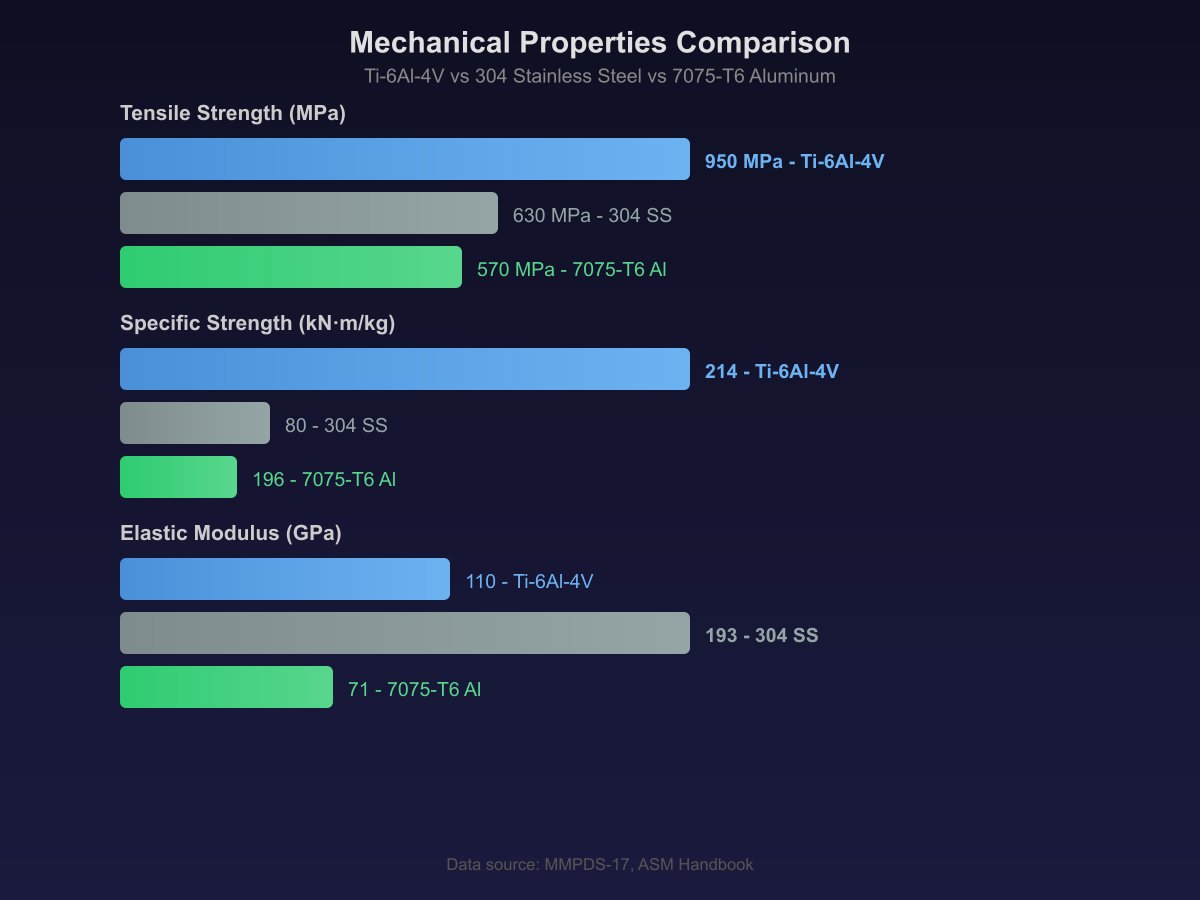
The starting point for any material selection is the spec sheet. The following table compares the most commonly specified alloys from each family in their typical delivery conditions. Note that heat treatment can significantly alter these values — particularly for aluminum and titanium alloys — and the table reflects annealed or T6-aged conditions as noted.
| Property | Ti-6Al-4V (Grade 5) | SS 304 (Annealed) | SS 316L (Annealed) | Al 6061-T6 | Al 7075-T6 |
|---|---|---|---|---|---|
| Density (g/cm³) | 4.43 | 8.00 | 8.00 | 2.70 | 2.81 |
| Tensile Strength (MPa) | 895–1,100 | 515–620 | 485–580 | 310 | 570 |
| Yield Strength (MPa) | 828–1,000 | 205–310 | 170–290 | 276 | 505 |
| Elongation (%) | 8–15 | 40–60 | 40–55 | 12 | 11 |
| Elastic Modulus (GPa) | 110 | 193 | 193 | 69 | 72 |
| Specific Strength (MPa·cm³/g) | 202–248 | 64–78 | 61–73 | 115 | 203 |
| Hardness (HRC) | 33–36 | 15–20 | 15–20 | ~60 HRB | ~87 HRB |
| Fatigue Endurance (MPa @ 10⁷) | 500–600 | 200–280 | 200–250 | 95–100 | 160 |
| Fracture Toughness (MPa√m) | 50–80 | >200 | >200 | 29 | 20–29 |
The numbers tell an important story. Titanium’s specific strength — tensile strength divided by density — is 2.5–3 times that of stainless steel and roughly equal to the best aluminum alloys. But aluminum achieves its specific strength through low density rather than high absolute strength, while titanium achieves it through genuinely high strength. This distinction matters enormously when section thickness or stiffness, rather than weight alone, is the design constraint.
Strength-to-Weight Ratio: The Aerospace Metric
In weight-critical applications — aircraft structures, spacecraft, high-performance automotive, and portable equipment — specific strength is the metric that drives design. It determines how much structure you need to carry a given load, and therefore what fraction of the vehicle or device mass is “dead weight.”
Titanium and aerospace aluminum (7075-T6) are nearly tied on raw specific strength, both around 200–210 MPa·cm³/g. But this snapshot comparison hides three important realities that favor titanium in demanding applications:
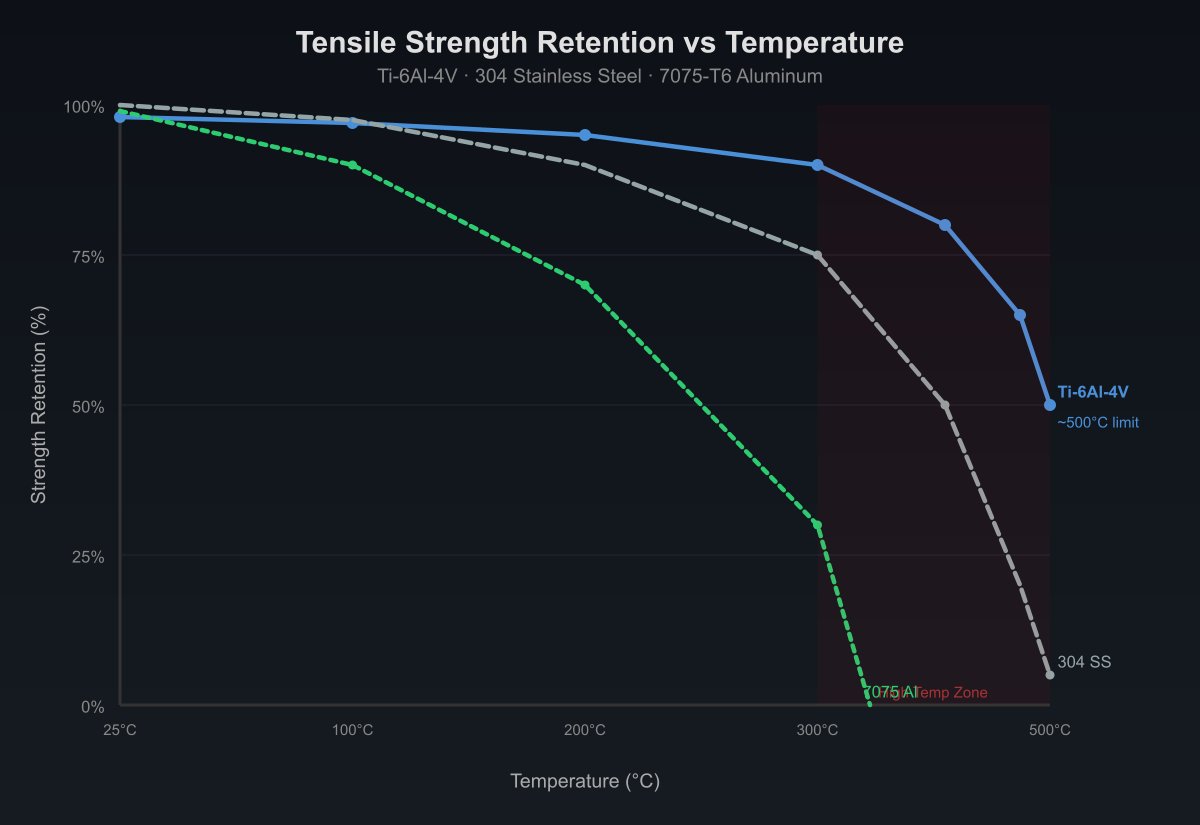
1. Temperature kills aluminum’s advantage. Aluminum 7075-T6 loses roughly 50% of its strength by 150°C and is effectively unusable above 200°C. Titanium maintains full strength to 350°C and useful strength to 400°C and beyond. In any application involving even moderate heating — engine compartments, airframe skins at supersonic speeds, exhaust-adjacent structures — titanium’s specific strength advantage becomes decisive.
2. Stiffness-driven designs favor titanium. Aircraft skins and many structural elements are stiffness-limited rather than strength-limited. Titanium’s elastic modulus of 110 GPa is 50% higher than aluminum’s 69–72 GPa. For a stiffness-governed panel of equal dimensions, a titanium panel will be stiffer for the same weight, or lighter for the same stiffness — despite having higher density.
3. Galvanic compatibility matters. Modern aircraft increasingly use carbon-fiber-reinforced polymer (CFRP) composites. Aluminum in contact with CFRP suffers severe galvanic corrosion without protective measures. Titanium is galvanically compatible with CFRP and requires no special isolation. This single property has driven titanium’s growing share of airframe structural weight on the Boeing 787 and Airbus A350.
Corrosion Resistance: Salt Spray, Seawater, and Chemical Environments
Corrosion resistance is where titanium establishes its most decisive advantage — and where stainless steel’s reputation sometimes exceeds its reality.
Seawater and Chloride Environments
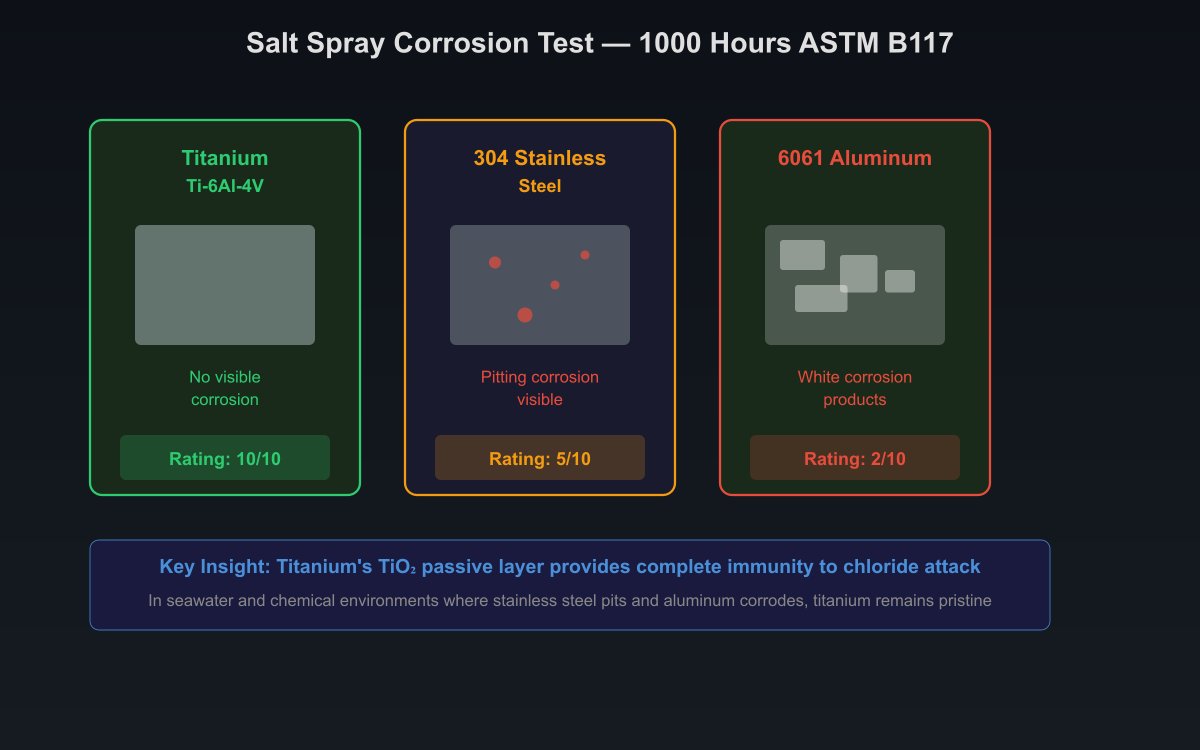
Titanium is virtually immune to seawater corrosion at all naturally occurring temperatures and flow conditions. It does not pit, does not crevice-corrode, and does not stress-corrosion-crack in seawater — three failure modes that plague stainless steel in marine service. Grade 2 (commercially pure) titanium handles all seawater applications; Grade 5 adds strength for structural components.
Stainless steel 304 offers negligible resistance to seawater pitting and is essentially unsuitable for any marine immersion application. Grade 316L provides improved resistance through molybdenum addition but remains vulnerable to crevice corrosion in stagnant seawater conditions — under gaskets, at flange joints, in threaded connections. The U.S. Navy’s experience with stainless steel seawater piping systems in the 1970s-80s was so poor that titanium became the standard replacement.
Aluminum in seawater presents a different problem: general corrosion rather than localized attack. Unprotected aluminum immersed in seawater corrodes at a steady rate (50–150 microns per year for common alloys). Anodizing and paint coatings slow but do not eliminate this attack, and any coating breach leads to localized corrosion. Aluminum is common for small marine hardware and above-deck structures, but is rarely used for critical immersed components without cathodic protection.
Industrial Chemical Environments
| Environment | Titanium | 316L SS | Aluminum |
|---|---|---|---|
| Seawater (all temperatures) | Immune | Susceptible to crevice corrosion | General corrosion |
| Nitric Acid (oxidizing) | Excellent | Good (concentration-dependent) | Good (>80% concentration) |
| Sulfuric Acid (reducing) | Limited (below ~5% or with inhibitors) | Moderate (concentration/temp dependent) | Poor |
| Hydrochloric Acid | Limited | Poor (pitting) | Poor |
| Chlorine (wet gas) | Excellent | Poor (rapid pitting) | Poor |
| Caustic (NaOH, KOH) | Moderate (temperature-dependent) | Excellent | Poor |
| Organic Acids | Good to excellent | Good to moderate | Moderate to poor |
High-Temperature Performance: Who Falters First?
Temperature is the great eliminator in material selection. Each metal family has a practical ceiling beyond which properties degrade beyond engineering acceptability.
Aluminum alloys are the first to bow out. Common structural grades like 6061-T6 and 7075-T6 derive their strength from precipitation hardening — fine metastable precipitates that coarsen and dissolve as temperature rises. At 150°C, 7075-T6 retains roughly 50% of its room-temperature strength. By 200°C, most aluminum alloys are structurally compromised. The practical ceiling for aluminum in load-bearing applications is approximately 150–180°C.
Stainless steels offer the widest temperature range of the three. Austenitic grades like 304 and 316 maintain useful strength to approximately 800°C, though oxidation and creep become limiting above 600–700°C. For high-temperature structural applications, specialized grades like 310 (25Cr-20Ni) and the precipitation-hardening grades (17-4PH) extend the range further. Stainless steel is the default choice when both moderate elevated temperature and low cost are required.
Titanium alloys occupy a distinct intermediate niche. They substantially outperform aluminum (useful to 400–600°C versus 150–180°C) while providing the weight savings that stainless steel cannot match. This makes titanium the ideal choice for applications that are too hot for aluminum but where stainless steel’s weight penalty is unacceptable — the exact profile of jet engine compressor components, high-performance automotive exhaust systems, and supersonic aircraft skins.
Fatigue Life and Cyclic Loading Behavior
Most structural failures occur not from monotonic overload, but from fatigue — the progressive accumulation of damage under repeated cyclic loading. The fatigue endurance limit (the stress below which the material can theoretically survive infinite cycles) varies dramatically across the three metal families.
Titanium alloys exhibit fatigue endurance limits of 40–60% of ultimate tensile strength — 500–600 MPa for Ti-6Al-4V in the annealed condition. This is two to three times the absolute fatigue strength of stainless steel and five to six times that of aluminum. Even on a specific-strength basis, titanium leads both competitors on fatigue performance.
Aluminum alloys have no true endurance limit — their S-N curves continue to decline at high cycle counts, meaning fatigue failure is possible at any stress level given sufficient cycles. Aluminum structures must therefore be designed to a finite-life criterion with scheduled inspection or replacement intervals. This is a fundamental design constraint for aluminum aircraft structures.
Stainless steels offer good fatigue performance in absolute terms (200–280 MPa endurance limit for 304) but modest specific fatigue strength due to their high density. The critical practical concern with stainless steel fatigue is its sensitivity to surface condition, notch effects, and — crucially — corrosion fatigue, where the combination of cyclic stress and corrosive environment can reduce fatigue life by an order of magnitude or more. Titanium is largely immune to corrosion fatigue in seawater and most industrial environments.
Thermal and Electrical Conductivity Considerations
Thermal conductivity influences heat exchanger design, machining behavior, and thermal stress management. The three metals occupy distinct positions on the conductivity spectrum:
| Property | Titanium | Stainless Steel 304 | Aluminum 6061 |
|---|---|---|---|
| Thermal Conductivity (W/m·K) | 6.7 | 16.2 | 167 |
| Electrical Resistivity (μΩ·cm) | 170 | 72 | 3.7 |
| Coefficient of Thermal Expansion (μm/m·K) | 8.6 | 17.3 | 23.6 |
Titanium’s low thermal conductivity is a disadvantage in heat exchanger applications — it requires more surface area to transfer the same heat load — but an advantage in applications where thermal isolation is desired, such as exhaust system components, turbocharger housings, and cryogenic equipment connections. Its low coefficient of thermal expansion (half that of stainless steel, one-third of aluminum) means reduced thermal stress in structures experiencing temperature gradients.
Aluminum dominates thermal management applications — heat sinks, radiator cores, and electronic enclosures — where its 25x conductivity advantage over titanium is decisive. Stainless steel occupies the middle ground, adequate for general service but inadequate for high-flux thermal applications where aluminum or copper are required.
Machinability and Fabrication: Cost Drivers on the Shop Floor
The cost of a finished component is often dominated by machining time, not raw material cost. Understanding the machinability of each material is therefore essential to accurate cost estimation.
Aluminum is the clear winner on machinability. It can be cut at high speeds (200–500+ m/min with carbide tooling), with low tool wear, excellent surface finish, and minimal power consumption. Complex aluminum parts can be machined in a single setup with high material removal rates. For cost-sensitive, high-volume production where material properties permit, aluminum is hard to beat.
Stainless steel is moderately difficult to machine. Austenitic grades like 304 and 316 work-harden aggressively — if the tool rubs instead of cuts, the surface hardens and subsequent cutting becomes progressively more difficult. Cutting speeds are typically 30–80 m/min with carbide tooling, and tool life is shorter than with carbon steel. Chip control is a constant challenge with the stringy, tough chips produced by austenitic grades.
Titanium is the most challenging of the three, primarily due to its low thermal conductivity (~7 W/m·K). Heat generated at the cutting edge cannot escape through the chip or workpiece and instead concentrates at the tool tip, accelerating tool wear. Cutting speeds are limited to 30–60 m/min — comparable to stainless steel — but tool life is typically shorter. The material’s low elastic modulus also means the workpiece deflects under cutting forces, requiring rigid setups and sharp tools. Machining titanium costs roughly 3–5 times more per hour than machining aluminum and 1.5–2 times more than stainless steel, a factor that must be included in component cost calculations.
Weldability, Joining, and Assembly Comparison
Aluminum welding requires careful oxide removal (aluminum oxide melts at ~2,000°C versus aluminum’s ~660°C melting point) but is otherwise straightforward with GTAW or GMAW. The heat-affected zone in heat-treated alloys like 6061-T6 loses strength, and post-weld heat treatment may be needed to restore properties. Friction stir welding has revolutionized aluminum joining for aerospace, producing high-quality welds with minimal distortion.
Stainless steel is the most forgiving to weld. Austenitic grades are readily welded by all common processes with minimal preheat or post-weld treatment — a major advantage for fabrication-intensive designs. The main concern is sensitization (chromium carbide precipitation at grain boundaries) in the heat-affected zone, which degrades corrosion resistance. Low-carbon grades (304L, 316L) or stabilized grades (321, 347) are specified when post-weld corrosion resistance is critical.
Titanium welding is demanding but well-established. The requirement for complete shielding of the weld zone from atmospheric contamination is non-negotiable — contamination at welding temperatures produces irreversible embrittlement. GTAW with primary, trailing, and back-purge argon shielding is standard, and critical welds are made inside argon-purged chambers. When properly executed, titanium welds are strong, ductile, and corrosion-resistant. The procedural discipline required adds cost but does not limit design possibilities.
The True Cost Picture: Material, Processing, and Lifecycle
Cost comparisons based solely on raw material price per kilogram are dangerously misleading. A complete cost analysis must account for material cost, processing and fabrication cost, and — critically for many applications — the financial consequences of in-service performance and service life.
| Cost Factor | Titanium | Stainless Steel | Aluminum |
|---|---|---|---|
| Raw material (relative to SS) | 5–15x | 1x (baseline) | 0.5–1x |
| Machining cost per hour | $$$$ | $$ | $ |
| Tooling consumption | High | Moderate | Low |
| Welding complexity | High | Low | Moderate |
| Maintenance frequency | Very low | Moderate | High |
| Service life in aggressive env. | 30+ years | 5–15 years | 3–10 years |
| Downtime cost exposure | Minimal | Significant | Significant |
The lifecycle cost argument for titanium is strongest in three scenarios: (1) aggressive environments where stainless steel or aluminum would require frequent replacement, (2) applications where downtime carries extremely high financial consequences (chemical plants, offshore platforms, power generation), and (3) weight-critical applications where each kilogram saved generates ongoing operational savings — fuel in aircraft, payload capacity in spacecraft, speed in motorsport.
In a chemical plant heat exchanger handling chlorinated process streams, a titanium exchanger that costs $500,000 but lasts 30 years may be dramatically cheaper than a stainless steel exchanger that costs $100,000 but requires replacement every 5 years — factoring in five additional procurement cycles, five installation shutdowns each costing $50,000–200,000 in lost production, and the escalating risk of an unplanned failure. Total lifecycle cost: $500,000 (titanium) versus $600,000–$2,000,000+ (stainless steel). The “expensive” option is actually the bargain.
Application Focus: Aerospace Structural Material Selection
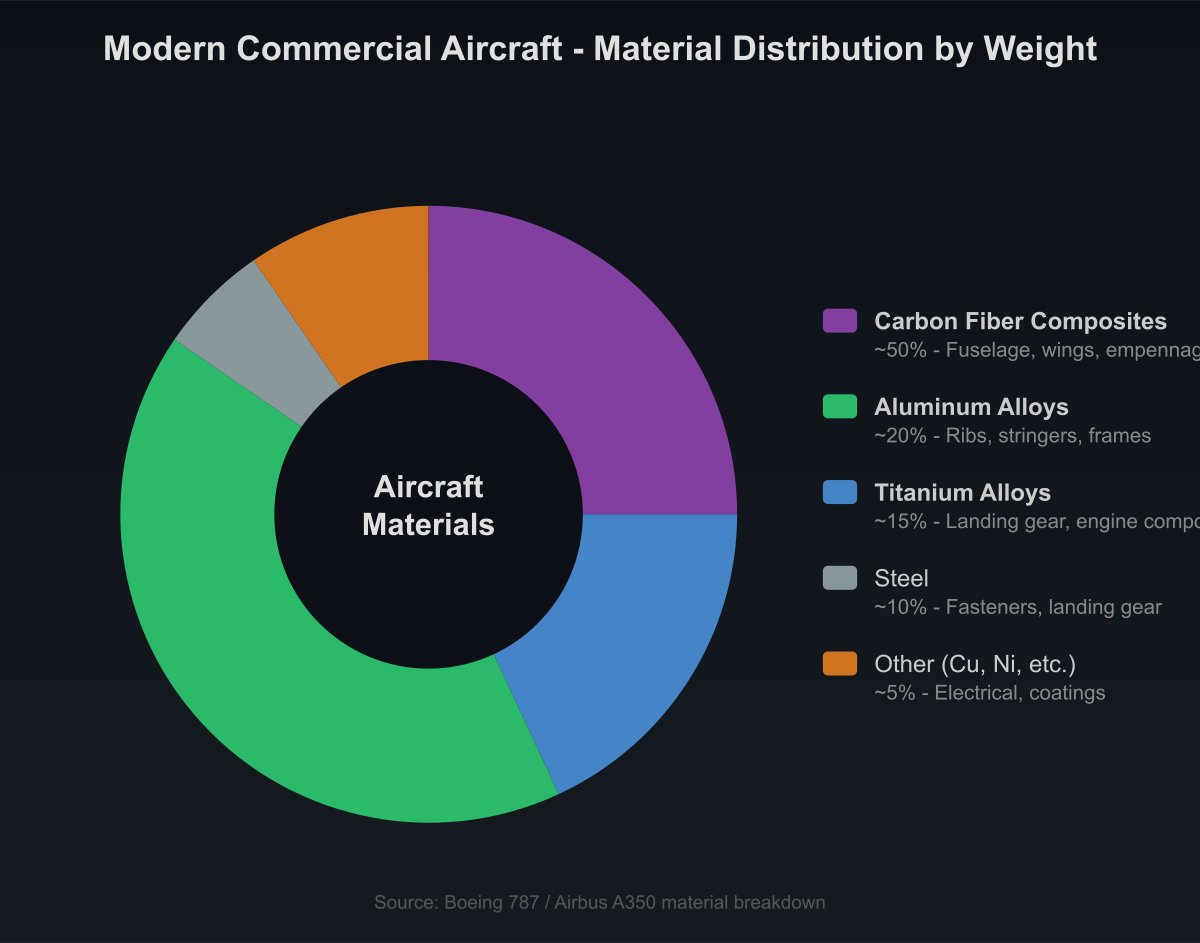
Aerospace material selection is dominated by weight — but not at any cost. The three metals play complementary roles in modern aircraft structures:
Aluminum (2000, 6000, 7000 series): The traditional airframe material. Used for fuselage skins, wing skins, stringers, and frames where high strength-to-weight at moderate temperature is required and galvanic isolation from CFRP is manageable. Aluminum remains cost-effective for airframe structures where it is not directly interfacing carbon composite.
Titanium (Ti-6Al-4V, Ti-5Al-2.5Sn): Used at CFRP interfaces (eliminating galvanic corrosion), in high-temperature zones near engines and APU, for landing gear support structures, and for critical fracture-sensitive forgings. Titanium’s share of airframe weight has grown from ~5% on aluminum-intensive aircraft to 15%+ on the composite-intensive 787 and A350.
Stainless steel: Limited aerospace structural role due to weight. Used primarily for high-temperature engine components (exhaust systems, afterburner components) and specialized fasteners where titanium’s strength is insufficient. Precipitation-hardening grades (17-4PH, 15-5PH) are preferred for these applications.
Application Focus: Marine and Offshore Engineering
The marine environment is corrosion’s proving ground. Saltwater, biological activity, and temperature cycles combine to attack metals through every available mechanism. Material selection here is fundamentally about managing corrosion.
Titanium: The gold standard for critical seawater-wetted components. Seawater piping on naval vessels, heat exchanger tubing in desalination plants, subsea valve bodies, propeller shafts, and fasteners. Titanium’s immunity to seawater corrosion eliminates maintenance and replacement cycles entirely. The U.S. Navy’s all-titanium seawater piping systems are expected to outlast the hull life of the vessels they serve.
Stainless steel (316L, duplex, super-duplex): Adequate for non-critical marine components and above-waterline structures but requires careful design to avoid crevice corrosion traps. Duplex and super-duplex grades (2205, 2507) offer improved pitting resistance at higher cost and are increasingly specified for offshore topside piping and structural components.
Aluminum (5000 and 6000 series marine grades): Common for small craft hulls, deck structures, and superstructures. Aluminum’s light weight and moderate cost make it attractive for weight-sensitive vessel designs, but it requires protective coatings and cathodic protection for immersed applications. The 5000 series (Al-Mg) offers the best marine corrosion resistance among aluminum alloys.
Application Focus: Medical Device and Implant Materials
Medical applications impose a unique constraint: the material must not harm the body, and the body must not degrade the material. This eliminates most aluminum alloys (toxicity concerns) and limits stainless steel options.
Titanium (CP Grade 4, Ti-6Al-4V ELI): The dominant implant material. Biocompatible, osseointegrating, and mechanically well-matched to bone. Used for hip and knee replacements, spinal fusion devices, dental implants, bone plates and screws, pacemaker cases, and surgical instruments. Titanium’s non-magnetic property also makes it essential for implantable devices that must be compatible with MRI imaging.
Stainless steel (316LVM, 22-13-5): Used for temporary implants (bone plates and screws intended for removal after healing), surgical instruments, and non-implanted medical device components. 316LVM (vacuum-melted, low-carbon) is the medical variant with improved corrosion resistance and cleanliness. Significantly cheaper than titanium for disposable and temporary applications.
Aluminum: Very limited medical role. Used in some external orthopedic devices (braces, frames) and non-critical hardware. Toxicity concerns restrict aluminum from implantable or long-term tissue-contact applications.
Application Focus: Automotive and Motorsport
In production automobiles, cost sensitivity has historically limited titanium to niche applications. Motorsport and premium vehicles operate under different economics:
Aluminum: The dominant lightweight automotive metal. Engine blocks, cylinder heads, wheels, suspension components, body panels, and structural castings. Modern vehicles contain 150–250 kg of aluminum on average, a figure that has doubled in 20 years driven by fuel economy regulations.
Stainless steel: Exhaust systems (409, 439 ferritic grades for corrosion resistance at moderate cost), fuel system components, and trim. The shift to higher exhaust temperatures with turbocharged engines has increased stainless steel usage in exhaust systems.
Titanium: Connecting rods, valves, valve retainers, turbocharger compressor wheels, exhaust systems, and suspension springs in Formula 1, MotoGP, and premium sports cars. Titanium exhaust systems on high-end vehicles can save 40–50% weight versus stainless steel while withstanding the extreme temperatures of modern turbocharged engines. Titanium springs save 60–70% weight versus steel — unsprung weight savings that directly improve suspension response.
Application Focus: Chemical Processing Equipment
Chemical processing imposes the most diverse and aggressive corrosion challenges of any industry, with material selection driven by compatibility with specific process chemistries at specific temperatures and concentrations.
Titanium: The default choice for wet chlorine gas service, chlorine dioxide bleach environments, nitric acid across wide concentration and temperature ranges, and chloride-containing process streams where stainless steel is susceptible to pitting and stress corrosion cracking. Titanium-clad or solid titanium vessels, columns, heat exchangers, and piping are standard in modern chlorine-chemical plants.
Stainless steel (304L, 316L, 2205, 904L, 254SMO): The workhorse material for the majority of chemical process equipment. Grade selection escalates with chloride content and temperature: 304L for general service, 316L for moderate chloride exposure, duplex 2205 for higher chloride environments, and super-austenitic grades (904L, 254SMO) for the most aggressive conditions short of requiring titanium or nickel alloys.
Aluminum: Limited chemical role due to poor acid resistance and susceptibility to both acidic and alkaline attack. Used primarily for nitric acid storage and transport at concentrations above 80%, where aluminum’s passivity in highly oxidizing conditions provides acceptable performance at low cost.
The Ultimate Decision Matrix
The following matrix synthesizes the preceding analysis into a practical selection guide based on the dominant design requirement.
| If Your Primary Requirement Is… | Best Choice | Why |
|---|---|---|
| Lowest weight, room temperature | Aluminum 7075-T6 or 2024-T3 | Best strength-to-weight at low cost |
| Lowest weight, elevated temperature (200–400°C) | Titanium Ti-6Al-4V | Aluminum fails; steel is too heavy |
| Maximum corrosion resistance (seawater) | Titanium Grade 2 | Immune to seawater; no coatings needed |
| Maximum corrosion resistance (acids) | Titanium or High-Alloy SS | Depends on specific acid and concentration |
| Lowest upfront cost | Aluminum or 304 SS | Least expensive per kg and to fabricate |
| Lowest lifecycle cost (aggressive env.) | Titanium | Eliminates replacement and downtime costs |
| Biocompatibility (implant) | Titanium | Osseointegrates; non-toxic; non-magnetic |
| High stiffness, low cost | Stainless Steel | Highest modulus per dollar |
| Best fatigue performance | Titanium | Highest absolute and specific fatigue strength |
| Best thermal conductivity | Aluminum | 25x titanium; 10x stainless steel |
| High temperature (>600°C) | Stainless Steel or Ni Alloy | Titanium oxidizes; aluminum melts |
| Food/beverage contact | Stainless Steel 316L | FDA compliant; easy to clean; economical |
Frequently Asked Questions
Which metal is strongest: titanium, stainless steel, or aluminum?
On absolute tensile strength, heat-treated titanium (Ti-6Al-4V STA at 1,100 MPa) and high-strength stainless steels (precipitation-hardening grades at 1,000–1,400 MPa) are comparable and both far exceed aluminum (570 MPa for 7075-T6). On specific strength (strength-to-weight), titanium and high-strength aluminum are comparable, both roughly 2.5–3 times better than stainless steel.
Is titanium more expensive than stainless steel?
Yes, titanium raw material typically costs 5–15 times more than stainless steel per kilogram. However, titanium components often have lower total lifecycle cost in aggressive environments due to eliminated maintenance, extended service life, and avoided downtime. The economic comparison must consider the full cost of ownership, not material price alone.
Can titanium be used in place of stainless steel?
In many applications, yes — particularly where corrosion resistance or weight savings justify the cost. Physical substitution is often straightforward (similar strength, non-magnetic), but thermal conductivity differences and galvanic compatibility with other materials must be considered. Titanium is not a drop-in replacement in heat exchanger applications without redesigning for lower thermal conductivity.
Does aluminum rust like steel?
Aluminum does not rust in the same way as steel because it contains no iron. However, aluminum does corrode — it forms a white aluminum oxide layer that is generally protective in atmospheric conditions but less effective in acidic, alkaline, or chloride-rich environments. Unprotected aluminum in seawater corrodes at a steady rate and requires coatings for long-term service.
Why is titanium used in aircraft instead of aluminum?
Titanium is used in aircraft where aluminum cannot meet requirements: at temperatures above 150–200°C (near engines, supersonic skins), at interfaces with carbon-fiber composites (to prevent galvanic corrosion), and in highly loaded structural forgings where aluminum would require excessive section thickness. Aluminum remains the primary airframe material for lower-temperature, cost-sensitive applications.
Conclusion: Making the Right Call
The choice between titanium, stainless steel, and aluminum is never one of universal superiority. It is a decision about which material’s strengths align with your application’s priorities — and which weaknesses you can accept. Aluminum excels when light weight, low cost, and good thermal conductivity are required at moderate temperatures. Stainless steel dominates when corrosion resistance at low cost, or high-temperature capability beyond titanium’s limits, is the driver. Titanium earns its premium when the application demands the combination that no other metal provides — light weight with strength, corrosion immunity without coatings, biocompatibility without compromise, and temperature capability beyond aluminum’s reach.
At Huaxiao Alloy, we supply titanium alloy products in sheet, plate, bar, pipe, tube, and wire forms with full certification and traceability. We also stock stainless steel and aluminum products for customers whose applications call for those materials. Our engineering team can help you navigate the material selection process — contact us to discuss your requirements.
Contact our team for material selection support, product availability, and quotation requests. We respond to all inquiries within one business day.