
Stainless Steel 304 vs 410: Which Is Right for Your Project?

Stainless Steel 304 vs 410

Introduction

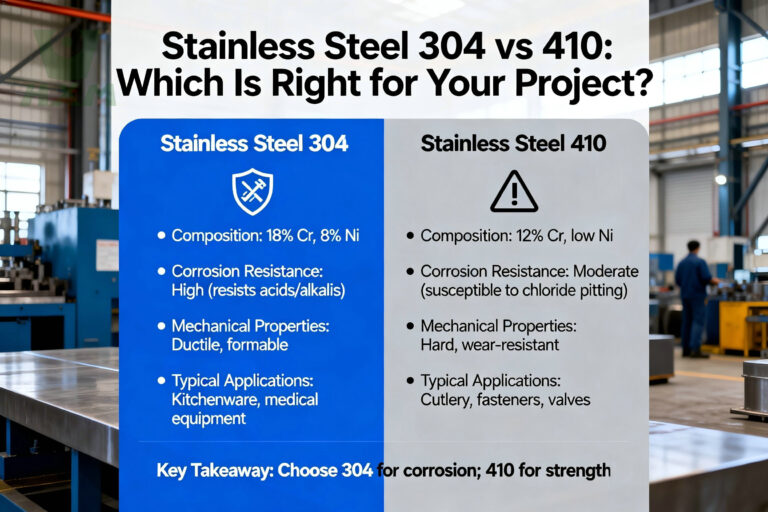
Choosing between 304 and 410 stainless steel is a common challenge in industries such as construction, manufacturing, automotive, and tooling. While both are stainless steels, they belong to different metallurgical families and offer very different performance characteristics.

Understanding the difference is critical to avoid:

  • Premature corrosion failure

  • Mechanical underperformance

  • Unnecessary cost increases

At Huaxiao-Alloy, we help global customers select the most suitable stainless steel grade based on application, environment, and budget.

1. What Is 304 Stainless Steel?

AISI 304 stainless steel is the most widely used austenitic stainless steel, known for its excellent corrosion resistance and versatility.

Key Composition

  • Chromium: 18–20%

  • Nickel: 8–10.5%

  • Low carbon

Key Features

  • Excellent corrosion resistance

  • Non-magnetic (annealed condition)

  • Excellent weldability and formability

  • Widely used in food and chemical industries

Typical Applications

  • Food processing equipment

  • Kitchenware

  • Chemical containers

  • Architectural structures

904L-stainless-steel-supplier

904L Stainless Steel

Huaxiao-Alloy: Premium 904L stainless steel manufacturer offering sheets, tubes, bars, and custom solutions. Explore specs, applications, and FAQs.
Get Quote»
316L-stainless-steel-supplier

316L Stainless Steel

Huaxiao-Alloy: Premium 316L stainless steel manufacturer offering sheets, tubes, bars, and custom fabrication. Explore specs, applications, and FAQs.
Get Quote»
316-stainless-steel-supplier

316 Stainless Steel

Huaxiao-Alloy: Premium 316 stainless steel manufacturer offering sheets, tubes, bars, and custom fabrication. Explore specs, applications, and FAQs.
Get Quote»
201-stainless-steel-supplier

201 Stainless Steel

Huaxiao-Alloy: Trusted 201 stainless steel manufacturer offering sheets, coils, bars, and custom fabrication. Explore specs, applications, and FAQs.

Get Quote»

2. What Is 410 Stainless Steel?

AISI 410 stainless steel is a martensitic stainless steel known for its high strength and hardness.

Key Composition

  • Chromium: 11.5–13.5%

  • Very low nickel (or none)

  • Higher carbon than 304

Key Features

  • High strength and hardness after heat treatment

  • Magnetic

  • Moderate corrosion resistance

  • Good wear resistance

Typical Applications

  • Valves and pumps

  • Shafts and fasteners

  • Turbine blades

  • Cutting tools

3. 304 vs 410 Stainless Steel: Core Differences

Property304 Stainless Steel410 Stainless Steel
StructureAusteniticMartensitic
Chromium18–20%11.5–13.5%
Nickel8–10.5%~0%
HardnessModerateHigh (after heat treatment)
Corrosion ResistanceExcellentModerate
MagnetismNon-magneticMagnetic
WeldabilityExcellentLimited
CostHigherLower

4. Corrosion Resistance Comparison

304 Stainless Steel

  • Excellent resistance to oxidation and corrosion

  • Performs well in:

    • Moist environments

    • Food processing

    • Chemical exposure

410 Stainless Steel

  • Basic corrosion resistance

  • Performs well in:

    • Mild atmospheric environments

  • Not suitable for:

    • Marine environments

    • Chemical exposure

👉 Conclusion:
If corrosion resistance is critical, 304 is the better choice.

5. Strength and Hardness

410 stainless steel significantly outperforms 304 in hardness.

Property304410
Hardness (HRC)~20Up to 50+
StrengthModerateHigh

👉 410 is ideal for:

  • Wear-resistant parts

  • Mechanical components

  • Load-bearing applications

👉 304 is better for:

  • Structural applications with corrosion exposure

6. Heat Treatment Differences

304 Stainless Steel

  • Cannot be hardened by heat treatment

  • Strength increased via cold working

410 Stainless Steel

  • Can be hardened and tempered

  • Achieves high strength and wear resistance

👉 This is a major deciding factor in industrial applications.

7. Weldability and Fabrication

Factor304410
WeldabilityExcellentLimited
MachiningModerateGood
FormabilityExcellentLow

410 requires:

  • Preheating
  • Post-weld heat treatment

304 is much easier to fabricate.

8. Cost Comparison

410 stainless steel is generally cheaper due to:

  • Lower nickel content
  • Simpler composition

However:

  • 304 may offer lower long-term cost due to corrosion resistance

9. Application-Based Selection Guide

Choose 304 Stainless Steel If:

✔ Corrosion resistance is critical
✔ Food-grade or hygienic applications
✔ Marine or chemical environments
✔ Complex fabrication required

Choose 410 Stainless Steel If:

✔ High strength and hardness needed
✔ Wear resistance is critical
✔ Cost reduction is important
✔ Environment is not highly corrosive

10. Real-World Use Case Comparison

IndustryRecommended Grade
Food Processing304
Marine Equipment304 / 316
Pump & Valve Components410
Cutting Tools410
Architectural Structures304
Automotive Parts410

11. Advantages and Limitations

304 Stainless Steel

Advantages:

  • Excellent corrosion resistance
  • Easy to weld and form
  • Wide application range

Limitations:

  • Lower hardness
  • Cannot be heat-treated

410 Stainless Steel

Advantages:

  • High strength and hardness
  • Wear resistance
  • Lower cost

Limitations:

  • Lower corrosion resistance
  • Difficult welding
  • Risk of brittleness

12. Why Choose Huaxiao-Alloy?

Huaxiao-Alloy is a global one-stop metal solutions provider, supplying stainless steel, carbon steel, aluminum, copper, nickel alloys, and titanium materials.

Our Stainless Steel Supply Includes:

  • 304 / 304L
  • 316 / 316L
  • 410 / 420 / 430
  • Duplex stainless steels

Our Advantages:

  • ASTM, EN, JIS, DIN compliance
  • EN 10204 3.1 certification
  • Custom sizes and processing
  • Competitive pricing
  • Fast global delivery

We help customers select the right grade—not just sell materials.

No. It has moderate corrosion resistance but can rust in harsh environments.

Only in non-corrosive environments where strength is more important.

Yes, significantly stronger after heat treatment.

304 is better due to corrosion resistance.

Final Conclusion

The choice between 304 and 410 stainless steel depends on your priorities:

  • Need corrosion resistance → 304
  • Need hardness and strength → 410

There is no universal “best”—only the right material for your application.

For expert guidance and reliable supply, contact Huaxiao-Alloy today.

Stainless Steel 304 vs 410: Which Is Right for Your Project?

Call Us Now!!!

7*24 Customer Service

Tel:

+86 21-57425826

+86 13012867759

Whatsapp:

+1 (579) 300-2733

Address

557RM, 3#LOU 1388#, JIANG YUE ROAD, Minhang District, Shanghai,  201114, SHANGHAI,  China

GET AN ENQUIRY NOW!!!